See you in Novi, Michigan next week. Elm Analytics will be at the MEMA OE Annual Conference & Expo, Nov. 18-19, just inside the entrance to the presentation hall. Come find us and say hi! We’d like to compare notes. -nick
Contents
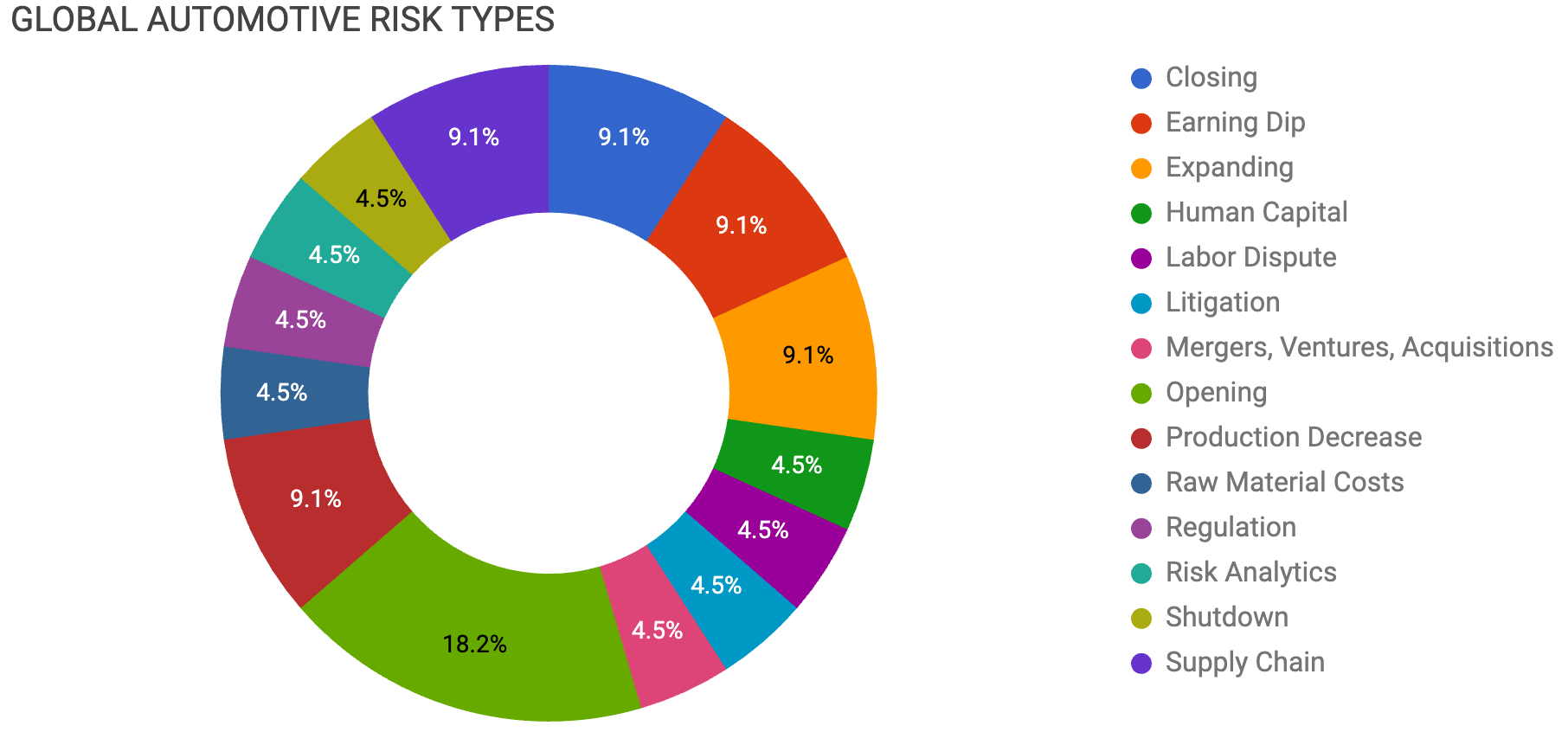
CLOSING
Stellantis agrees to sell Brampton plant
NexPoint to close Alabama polycarbonate plant
EARNING DIP
Nissan quarterly operating profit plunges 96%
Mitsubishi cuts profit outlook to $445M
EXPANDING
OPmobility plans five more Indian plants
Kia plans $2B second Indian plant
HUMAN CAPITAL
Volkswagen cutbacks trigger Puebla supplier layoffs
LABOR DISPUTE
IG Metall plans 24-hour German strike
LITIGATION
Nexperia sues Wingtech and Chinese unit
MERGERS, VENTURES, ACQUISITIONS
Sanko Gosei acquires Alabama plastics molder
OPENING
Honda plans $3B Ohio hybrid plant
OPmobility plans new Missouri plant
Desay SV opens Spanish cockpit plant
BASF starts expanded Louisiana MDI production
PRODUCTION DECREASE
Tesla to end Cybertruck production mid-2027
Volkswagen scraps Wolfsburg future production plan
RAW MATERIAL COSTS
Suppliers press automakers for inflation compensation
REGULATION
EU considers delaying UK EV tariffs
RISK ANALYTICS
SMMT seeks support for struggling suppliers
SHUTDOWN
Stellantis extends Mirafiori Fiat 500 shutdown
SUPPLY CHAIN
Automotive PCB waits reach 20 weeks
Chipmakers warn AI squeezes automotive supply

Closing
Stellantis has agreed to sell its idle Brampton, Ontario, assembly plant and equipment to local armored-vehicle maker Roshel. That ends car production at the 69-acre site (Issues #500, #502, and #505 covered the talks). The price was not disclosed, and the deal should close by year-end if regulators approve. Stellantis says the sale helps it reach about 80% capacity utilization in North America by 2030. Since the announcement, Ottawa has served Stellantis a notice of default on its funding deal. Stellantis has 30 days to fix the breaches or face legal action, and it has offered to repay the federal money for Brampton. Unifor says the sale breaks its contract. Its members voted 97.3% for a strike mandate in October, but the union is not yet in a legal strike position. The Jeep Compass production that Brampton was retooling for now goes to Belvidere, Illinois. With Brampton gone, a Unifor strike would land on Windsor Assembly, Stellantis's last Canadian car plant.
Upstream, capacity is leaving too. NexPoint Materials will close its polycarbonate (PC) plant in Burkville, Alabama, by the end of March 2027 and move its Lexan output to Mount Vernon, Indiana. Burkville is the largest PC plant in the Western Hemisphere and holds 36% of US capacity. Weak exports, cheap imports, and years of low utilization have made it unprofitable. NexPoint says most customers won't be affected. NexPoint is SABIC's former plastics unit, which Mutares bought and launched in August. Autos made up 39% of the unit's sales under SABIC, per Mutares. Suppliers who mold headlamp lenses and light covers from Burkville grades will likely confirm those grades are requalified at Mount Vernon before March.

Earning Dip
Nissan's operating profit fell 96% in its July-September quarter to $13M, from $327M. Higher raw material and selling costs hurt, along with a July earthquake that halted Japanese production for weeks (previously Issue #493). The year-earlier quarter was also inflated by a one-time gain on US emissions rules. China is the bigger problem. Nissan now sees China sales of 370k to 400k, down as much as 43%, and cut its global forecast to 2.97M to 3M vehicles. It raised its outlook to 1.35M in North America and 435k in Japan, and kept its full-year operating profit target of $1.27B.
Mitsubishi Motors' problem is the Middle East, not China. It now expects operating profit to fall 7.3% this fiscal year to $445M, down from $572M in August, with net income expected to stay flat. The conflict will cost about $286M in lost sales and higher freight and raw material costs. Mitsubishi had planned for the Strait of Hormuz to reopen by the end of June. It cut its global sales forecast to 764k vehicles, down 4.1%, with North America off 7% to 154k and Southeast Asia off 12% to 216k. High fuel prices are pushing Southeast Asian buyers toward hybrids, where Mitsubishi's lineup is thin. Most of the $286M is freight and materials, the same costs suppliers are now trying to pass on to automakers below.

Expanding
French supplier OPmobility plans to add about one plant a year in India for the next five years, backed by roughly $336M of investment over the next two. Its six plants, four making fuel tanks and two exterior parts, run at high utilization and mostly on three shifts. A new fuel tank plant at Kharkhoda, Haryana, a 55/45 joint venture with Maruti Suzuki, will make about 1M tanks a year for Maruti alone. Capacity is also doubling at the $39M plant in Badhalwadi, Pune, that opened last year. India revenue has grown more than 20% a year for five years, against about 5% market growth, as OPmobility moves into tailgates, exterior modules with lighting, and fuel tanks built for hybrids. With six plants on three shifts, surge capacity is limited until new plants open, so expect tight allocation for new India programs.
Kia is adding India capacity too. Kia India and its suppliers will invest $2B in a second plant in Andhra Pradesh, with 200k units of annual capacity and production from early 2030. The 465-acre site includes land for suppliers and will have stamping, welding, paint, and assembly for both combustion and electric models. With the 430k-unit Anantapur plant, Kia’s India capacity rises to about 630k, and total investment with suppliers reaches $5B. Kia puts the direct and indirect workforce needed at about 12k. Supplier land is built into the 465 acres, so Anantapur’s supply base will be asked to commit capital well ahead of the 2030 start.

Human Capital
In Mexico, Volkswagen's cutbacks at Puebla have cost the state's auto parts sector about 1.4k jobs, according to Carlos Sosa Spínola, who heads the Puebla chapter of manufacturing chamber Canacintra. He says 70% of the 350 parts makers there have lost output or jobs as VW adjusted production and dropped a shift (VW cut the third shift on its Jetta and Tiguan lines in August). Metalworking and plastics suppliers are feeling it too. He doesn't expect the jobs back this year and is counting on Golf production in 2027 to restore them. The Golf moves from Wolfsburg to Puebla in 2027, and Issue #506 noted the first pre-production units in September.

Labor
Labor pressure is building in Germany as well. IG Metall will call a 24-hour strike after three rounds of pay talks made no progress. No date is set yet. The talks cover 3.7M metal and electrical workers at Audi, Mercedes-Benz, Tata Steel and others (Issue #507 covered the offer and the first walkouts). The union has proposed letting workers at struggling companies accept concessions if those companies make binding commitments on jobs and investment. Employers say longer strikes will only deepen the crisis.

Litigation
Nexperia has sued its Chinese parent Wingtech, Wingtech founder Zhang Xuezheng and its own China unit in a Dutch court. The suit is reported at $2B, but Nexperia hasn’t named a figure. The suit alleges the China unit has ignored its rules since October 2025 and told customers to pay into accounts it did not approve. A court in The Hague has also barred the unit from using Nexperia’s patents and other IP. Court-appointed administrators want to split the company. A new investor would control the business outside China, and Wingtech would keep the China side. Wingtech rejects the plan. (Issue #501 covered the Dongguan court’s freeze of Nexperia’s China assets.) The administrators’ plan would formalize what supply already looks like: Western wafers with packaging in Malaysia and the Philippines, and a Chinese unit building its own wafer base.

Mergers, Ventures, Acquisitions
Japan's Sanko Gosei has bought Cumberland Plastic Systems in Opelika, Alabama, giving the molder its second US plant. It says automakers want more parts made locally, including hybrid parts, because of trade policy. Cumberland adds about 135 workers, more than 40 presses and over 200k ft², and had 2025 sales of $48.4M. Sanko Gosei now runs about 90 presses in the US, from 100 to 3.5k tons, and also has plants in Fort Wayne, Indiana, and Celaya, Mexico. It plans to add large presses in Opelika.

Opening
Honda will build a $3B hybrid plant in central Ohio that can make 240k vehicles a year, starting in 2029 (Issue #501 reported the talks). It will need about 2k workers and lifts Honda’s US capacity to 1.3M and its North American capacity to 1.9M. Honda will also build a new V6 hybrid engine in Alabama and retool its Ohio engine plant for a new four-cylinder. Transmission plants in Ohio and Georgia get retooled, and engine output returns to Ontario (the engine plant is in Anna, Ohio; the transmission plants are in Russells Point, Ohio, and Tallapoosa, Georgia; and the Alabama V6 work is at Lincoln). Another $338M goes to Ohio. In Canada, Honda will spend $614M, with $117M of it at Alliston, where Ottawa adds $222M. The engine and transmission work hits Honda’s current suppliers first, years before the new plant opens in 2029.
OPmobility is also growing in the US. It will lease a 213k ft² site in Riverside, Missouri, near Kansas City, and expects to need more than 100 workers (Issue #485 covered its Rossford, Ohio, plant). The company hasn’t said what the plant will make or for whom (Ford’s Kansas City Assembly in Claycomo, which builds the F-150 and Transit, is nearby).
Chinese electronics supplier Desay SV has opened a plant in Linares, Spain, to make dashboard screens and cockpit controllers for carmakers in Europe (the Santana Tech Park site was the Santana Motor plant, which closed in 2011). The 215k ft² plant can make 2.8M units a year, worth about $426M at full rate. Mass production starts in the first quarter of 2027. Its team in Spain is already signing up local suppliers of materials, tooling, and molds.
BASF has started up the final phase of a roughly $1B expansion at Geismar, Louisiana. It nearly doubles the site’s MDI capacity to about 600k metric tons a year, making BASF the largest maker in North America. MDI, methylene diphenyl diisocyanate, is a chemical compound used to produce polyurethanes. The project also adds aniline, an MDI feedstock BASF can now sell directly to North American customers. BASF hasn’t said when the site will reach full capacity. MDI goes into polyurethane seat foam, instrument panels, and steering wheels, so this adds North American supply the same week a polycarbonate plant closes.

Production Decrease
Tesla will wind down Cybertruck production at Gigafactory Texas around mid-2027, about three and a half years after first deliveries. Elon Musk says the space is needed for Cybercab output. Tesla doesn’t report Cybertruck sales. Electrek puts the pace at about 30k a year, on a line planned for 250k with more than 125k already installed. Cox Automotive estimates fewer than 4k US sales in each of the first two quarters of 2026. Tesla hasn’t said what happens to service parts. (previously, in Issue #494, Tesla went to court to recover Cybertruck tooling from Angstrom in Troy, Texas.)
Volkswagen is pulling back too. It has dropped its “Gamechanger” plan for building future models at Wolfsburg, less than two weeks after it paused work on the electric Golf there. Works council chief Daniela Cavallo called it a dramatic break from the December 2024 agreement, which traded job cuts for investment and employment guarantees. Labor has threatened strikes from Jan. 1 as VW plans 100k job cuts and up to four German plant closures. With the combustion Golf moving to Puebla in 2027 and the electric Golf on hold, Wolfsburg’s supply base has no clear next-generation program to quote.

Raw Material Costs
Suppliers are pushing harder to pass inflation on to automakers. Adient puts its hit from Iran war fuel surcharges and freight at about $35M, plus higher labor costs at two plants after UAW talks, and its incoming CFO says it is “dedicated to getting money out of everybody.” Magna, Lear and Forvia also flagged fuel costs. Aptiv expects $700M of chip inflation next year from AI and data center demand and says it cannot ship parts without automaker funding commitments. Steel and aluminum are often indexed, but most other contract terms are fixed-price. That leaves Tier 1s at risk of getting stuck between their suppliers’ increases and customers who won’t pay, said supplier attorney Dan Rustmann of Butzel Long. (Issue #506 covered Ford’s $2.5B in commodity headwinds. Aptiv’s $700M is the AI-driven electronics inflation covered in the Supply Chain section below.)

Regulation
The EU is set to delay the 10% tariff on most electric vehicles traded with the UK, due from Jan. 1, the Financial Times reported. EVs pay the tariff unless at least 55% of their value comes from the EU or UK, with higher thresholds of 65% for battery cells and modules and 70% for packs. SMMT has put the cost to EV makers at $1.86B (Issue #489 covered the estimate). Nothing has been agreed yet. The Commission has floated a one-year delay or a two-year scheme letting automakers offset exports with non-compliant batteries against compliant models sold at home. UK officials expect serious talks after the Nov. 20 EU-UK summit, and the EU chemicals industry is lobbying against any delay.

Risk Analytics
SMMT’s larger worry is the supply base itself. A report it paid for says high labor and energy costs, shaky demand, and program delays are draining suppliers’ cash and investment. Some run parts of their business at about half capacity. Insolvencies among UK vehicle and parts makers rose about 180% from 2016 to 2025, against about 63% for all UK firms. SMMT wants $133M in grants for equipment and $33M for skills. It also wants DRIVE35 funds opened to parts for all powertrains, help paying for tooling, and a $6.6M program to help suppliers move into aerospace and defense. The UK supply base counts more than 2.5k businesses and 188k jobs. The aerospace and defense fund points the same way as Brampton: auto capacity looking for a defense customer.

Shutdown
Stellantis' Mirafiori plant in Turin will stay shut down for Fiat 500 production through Nov. 20, a fifth straight week, unions said (Issue #507 covered the ECU shortage). FIM-CISL blames both a component shortage and weak demand for the 500. It called an MF report credible that Mirafiori will run only two more weeks this year and build just over 50k cars in 2026. Stellantis says stoppages at some Italian plants tied to a shortage of a component for the N3 GSE engine control unit could run through December.

Supply Chain
Whatever the cause at Mirafiori, the wider squeeze on automotive electronics is coming from AI. Lead times for car circuit boards (PCBs) have grown from two or three weeks to about 20, Aumovio’s China COO said at its supplier conference. The choke point is upstream, in laminates, prepreg and glass cloth. The ultra-thin cloth AI servers need is woven on looms from Toyota Industries, which holds over 90% of that market, is booked to 2030 and stopped taking new high-end orders in May. Cloth makers are shifting to thin grades and away from the thicker cloth car boards use. Stockpiling won’t help much. Some prepreg expires in three months, and each board fits only one model. Speakers at the conference urged second sources and visibility down to Tiers 4 and 5 (Full disclosure: supply chain mapping to Tier-N is central to Elm Analytics’ supply chain risk offerings). One supplier executive called 2027 the worst year yet for auto supply. (previously in Issue #507: Aumovio expects a $1.1B chip cost hit in 2027.)