Dear Reader,
The first useful thing to know about the Kumamoto earthquake was not which plants went down.
It was that every train on Kyushu had stopped, including the Shinkansen; a cargo train had derailed at Yatsushiro; the airport runway was closed; the Kyushu Expressway was damaged; and 45k households had no power.
None of that names a supplier. All of it tells you production is at risk. We posted it as a Manufacturing Operational Impact Alert while the situation was still moving, days before the plant-by-plant picture resolved.
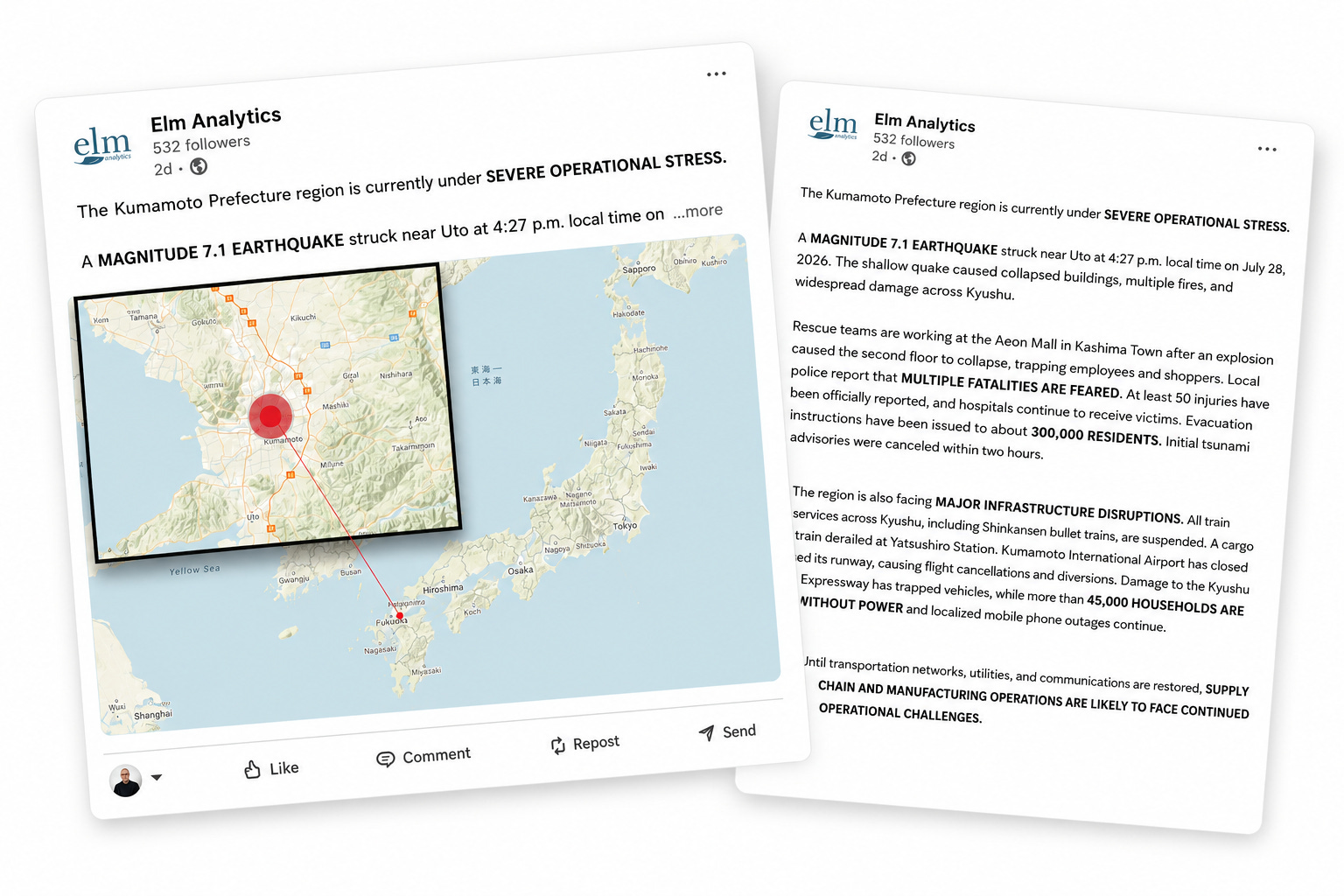
We publish these on our LinkedIn page as events surface. Follow along if you want them when they matter. Then read on.
Best,
Nick Gaydos
Editor
Contents
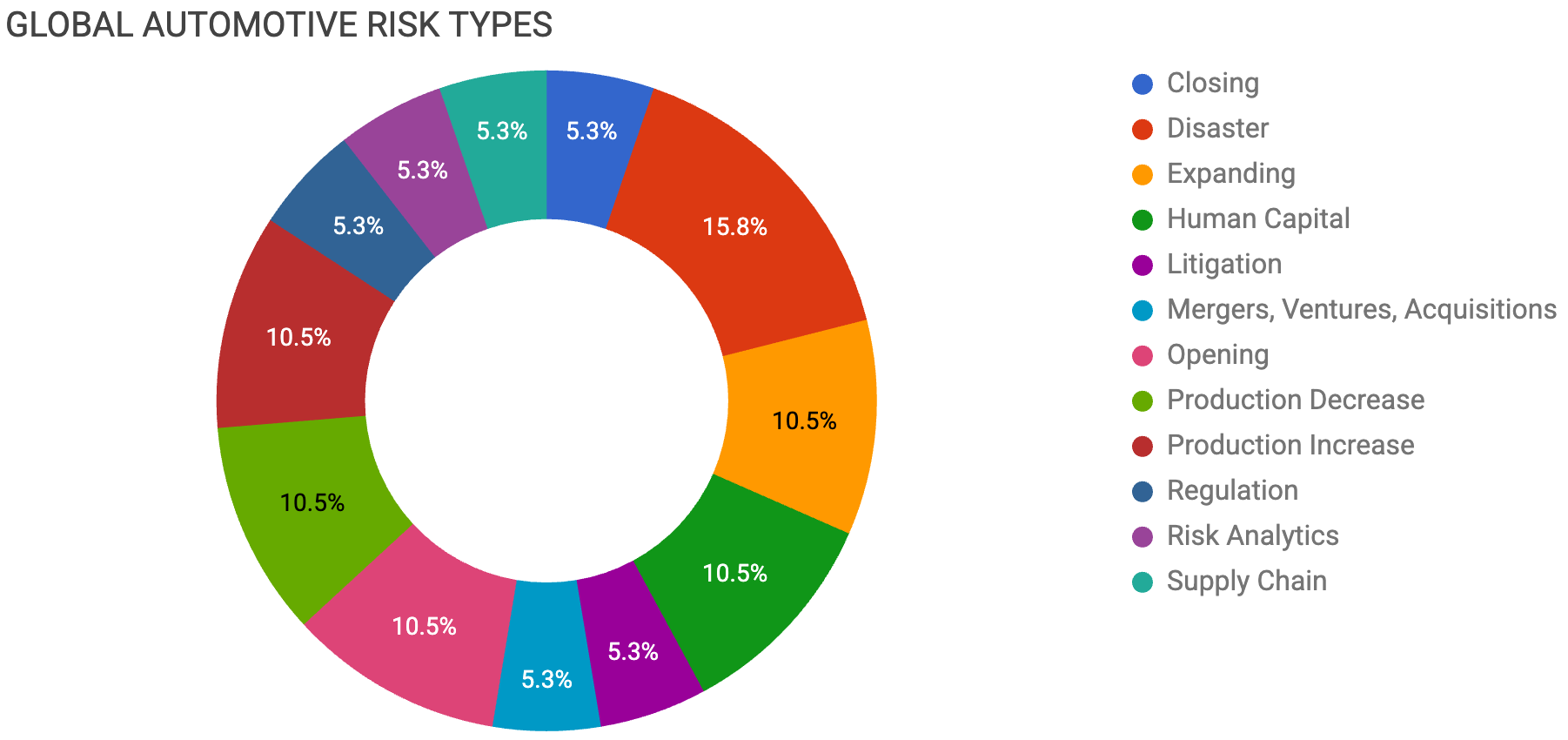
CLOSING
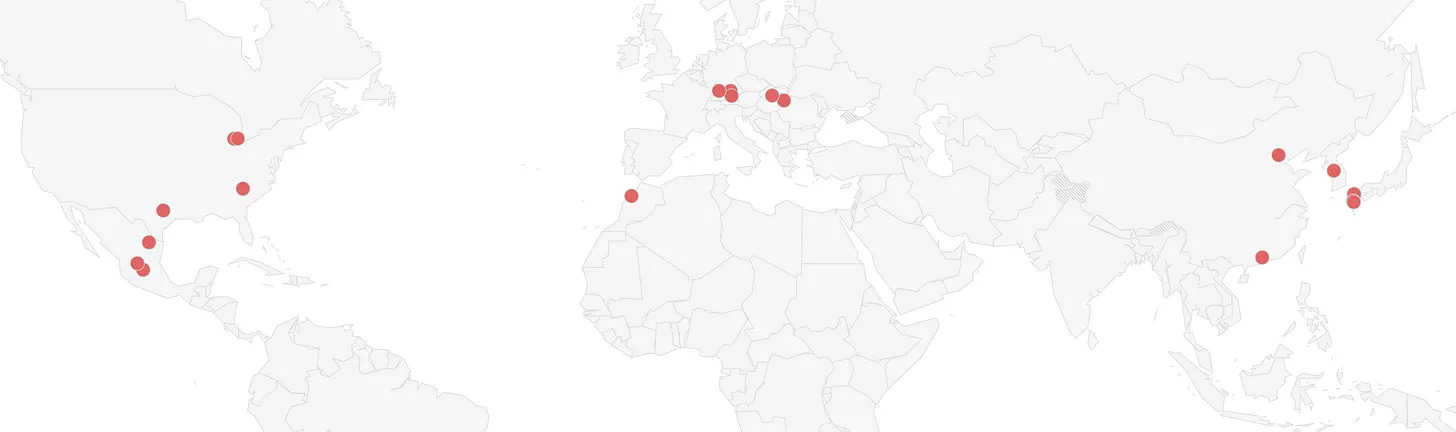
Mata Automotive closes Slovakia plant
DISASTER
Earthquake disrupts Kyushu automotive production
Renesas, Sony, JASM halt operations
Aisin, Mitsubishi, Daihatsu face shortages
EXPANDING
Kia invests in Mexico EV3 production
Fuji OOZX expands Guanajuato capacity
HUMAN CAPITAL
BMW plans voluntary workforce restructuring
Porsche expands job reduction program
LITIGATION
Tesla seeks Cybertruck tooling retrieval
MERGERS, VENTURES, ACQUISITIONS
SK On evaluates Factorial solid-state cell production
OPENING
Huatai Mould opens first Americas plant
Gentex targets Morocco production by 2028
PRODUCTION DECREASE
Li Auto headlight shortage loses 4k planned units
Audi reassigns 1,200 Neckarsulm workers
PRODUCTION INCREASE
Battery production starts at BMW Woodruff
BMW Debrecen reaches production milestone
REGULATION
China inspects EV manufacturing compliance
RISK ANALYTICS
CAR details tariff supply risks
SUPPLY CHAIN
Bridge cuts Windsor-Detroit truck delays

Closing
Turkish supplier Mata Automotive will close its plant in Nová Ves, in the Veľký Krtíš district of southern Slovakia, by November 30, cutting about 120 jobs. The site makes wood and carbon fiber interior trim for Cadillac, Aston Martin, JLR and Chrysler vehicles. Revenue had fallen from about $10.5M in earlier years to $6.5M last year, profit dropped to $126k, and headcount was already cut from about 220 in 2022. The company tied the closure to weak European demand. Low-volume cosmetic interior trim is among the first parts of the supply base to fail when European premium build rates soften, and re-sourcing wood and carbon fiber parts is a specialty search rather than a commodity one.

Disaster
A magnitude 7.1 earthquake struck the Kumamoto region of Kyushu on July 28, killing at least 17 people, damaging roads and cutting power to thousands of homes. Toyota suspended its Miyata, Kanda and Kokura plants in Fukuoka Prefecture from late July 29 through today, citing safety, logistics and supplier status. Miyata builds Lexus models including the ES sedan and the UX, RX and NX crossovers, has annual capacity near 430k vehicles, and exports roughly 90% of its output. Nissan Motor Kyushu and Nissan Shatai Kyushu, which build the X-Trail, Kicks and Serena along with the Infiniti QX80, Nissan Patrol and Armada, moved to partial suspensions on earthquake-related parts delays. Autos and semiconductors account for roughly two-fifths of the region’s industrial output, according to Japan’s industry ministry.
The Kumamoto semiconductor cluster took the same hit:
Renesas halted its Kawajiri and Nishiki plants after fallen ceiling panels, wall cracks and water leaks.
Sony Semiconductor’s Kumamoto Technology Centre remained down while the company assessed building and line damage.
TSMC unit JASM evacuated its Kumamoto fab.
Tokyo Electron stopped two sites and expects a full restart early next week.
Mitsubishi Electric partially restored cleanroom work at two power semiconductor plants.
Toppan reopened its Tamana site without resuming semiconductor component output.
Ebara halted a Nankan plant that makes chipmaking equipment.
Tokai Carbon partially resumed graphite electrode production at Ashikita.
Power semiconductors and image sensors from this cluster feed vehicle programs well beyond Japan, so the exposure is not limited to automakers with plants on the island.
The second-order effect is already visible:
Aisin, a core Toyota Group supplier, halted its Kumamoto City plant while inspecting damage.
Mitsubishi Motors has no Kyushu assembly line but suspended some production at its Okayama plant due to quake-driven supply disruption.
Daihatsu suspended a small car plant and an engine plant in Kyushu, citing supplier issues.
Takahide Kiuchi of Nomura Research Institute estimated losses would stay below 1T yen, or about $6.11B, and called the production impact relatively temporary. Analysts have attributed most shutdowns to worker safety precautions rather than facility damage. Even where plants are undamaged, supplier-driven shortfalls usually surface days later, so the risk window for this event stays open into next week.

Expanding
Kia will invest $649M in Mexico between 2026 and 2028 to build the all-electric EV3 at its Pesquería plant in Nuevo León, shifting production from South Korea. The line is scheduled to start on August 4 and will launch at 27% local content, a target both Kia and the Mexican government intend to raise. Economy Minister Marcelo Ebrard said the program will create 500 direct jobs in 2026 and 1.5k more between 2027 and 2030, and that the plant will serve both domestic and export markets. The local content target is the actionable part for suppliers. A first EV line at Pesquería opens sourcing for battery packs, e-drive components, and EV-specific thermal and interior parts that the plant's combustion programs never required.

Fuji OOZX will spend about $10M to expand its Guanajuato plant, adding building space and new production lines. The Japanese company makes powertrain components including engine valves, and says the expansion will lift the Mexican subsidiary’s capacity to 2.3M units per month. Fuji OOZX framed the move as a response to shifting North American demand and to economic security and trade requirements under USMCA.

Human Capital
BMW has reached an agreement with labor representatives on a workforce restructuring program built around voluntary severance. A person familiar with the matter told the Wall Street Journal the program could reportedly affect up to 8k workers in Germany, a figure BMW has not confirmed. Second-quarter EBIT fell 39% year over year, and revenue dropped 8% to about $35.85B, with the automotive operating margin down to 2.3% from 5.4%. BMW expects lower full-year deliveries and an automotive margin of 1% to 3%, against 5.3% in 2025. A 30% drop in Chinese sales is doing most of the damage, which means the German supplier base is absorbing a demand problem that originates outside Germany.
Porsche will cut 5k jobs through early retirement and other voluntary measures under an agreement with worker representatives, on top of 3.9k positions agreed last year against a base of roughly 42k employees at the end of 2025. In exchange, the company guaranteed the future of its core German sites and committed about $2.4B in investment through 2035, while workers accepted smaller bonuses and pay increases and less remote work. Chinese sales fell 32% in the first half of 2026 after dropping to 41,938 units last year, and US tariffs cost Porsche roughly $800M last year on a fully imported lineup. CEO Michael Leiters is due to deliver a full strategy in early October and has already moved to sell stakes in Bugatti and Rimac.

Litigation
Tesla filed an emergency complaint on July 23 in the US District Court for the Western District of Texas seeking access to tooling held at a Troy, Texas plant operated by Angstrom Automotive Group. According to the filing, Angstrom told Tesla on July 13 that it would close the plant and would not agree to a retrieval plan, then offered to keep the line running for an additional $250k per week, and about 700 finished components scheduled to ship on July 17 never left the building.
Tesla says a July 21 retrieval attempt accompanied by law enforcement was turned away, that replacement tooling would take five to six months to fabricate, and that several thousand customer-committed Cybertrucks are at risk. The complaint asks only for physical retrieval of the die-cast tools, trim dies, fixtures, gauges, and X-ray equipment Tesla says it owns, not damages or resolution of the underlying contract dispute.
Angstrom, which acquired the Troy plant from Anderton Casting in early 2025, has not publicly responded, and the court has not ruled. The key takeaway is that owning tooling and having access to tooling are different things, and a supplier closure notice is the moment that gap becomes expensive.

Mergers, Ventures, Acquisitions
SK On and Factorial Energy signed a memorandum of understanding to assess whether SK On's existing battery plants can support production of Factorial's FEST solid-state cells. The agreement is a feasibility study, not a manufacturing commitment. SK On has more than 200 GWh of annual capacity globally, roughly 100 GWh of it in the US, and supplies Hyundai, Ford and Volkswagen. Factorial is already working with Mercedes-Benz, Hyundai, Kia and Stellantis.

Opening
Chinese tooling and casting manufacturer Huatai Mould will invest about $29.8M in its first plant in the Americas, at La Aurora Industrial Park in San Francisco de los Romo, Aguascalientes, Mexico. The site will produce high- and low-pressure casting molds, tooling, precision machining, and aluminum and zinc components, with roughly 250 specialized jobs and operations starting by the end of 2026. Huatai runs six plants in China, and this is its first production footprint in the Western Hemisphere. Tooling lead times and cost were named at this week’s CAR roundtable as a live constraint on reshoring. Chinese tooling capacity landing inside Mexico is one answer to that, and a complicated one for anyone sourcing against USMCA content rules.
Gentex has signed a letter of intent and selected a site for a plant in Morocco, targeting 2028 production of electrochromic mirrors and electronic modules for vehicles built and sold in Europe. COO Neil Boehm said European customers increasingly require regional manufacturing to derisk their supply base, and that Gentex expects to keep core technology production at existing sites to avoid creating excess capacity.

Production Decrease
A headlight supply shortfall cut Li i6 production by about 4k units against plan in mid to late July, product line head Li Xinyang said, and deliveries this month may fall as a result. Li Auto says headlight supply and vehicle output have returned to normal and that it is working with suppliers to recover the lost volume. The i6 accounted for 69% of Li Auto’s June deliveries, and the company posted a first-quarter net loss of about $339M with gross margin down to 7.9% from 20.5% a year earlier. A single lighting supplier moving 4k units of an automaker’s volume driver is a reminder that Chinese EV makers carry the same single-source exposure as everyone else, without the balance sheet to absorb it.
Audi will eliminate the night shift at its Neckarsulm plant in November, moving about 1.2k employees to daytime operations. Neckarsulm runs at 225k units of annual capacity, around 75k below previous years, and has not secured any battery-electric program after the current A5 and A6 life cycles. The end of A8 production frees space in the plant’s newest assembly hall, where Audi will consolidate A5 sedan and wagon variants. German press reports have linked the site to future Premium Platform Electric derivatives or Scalable Systems Platform vehicles. Still, Audi has not confirmed any allocation, and Volkswagen Group decisions are expected later this year.

Production Increase
BMW will start series production of high-voltage batteries at Plant Woodruff, South Carolina, in December, supplying the 2027 iX5 built at Spartanburg 15 miles away. The company has put about $1.7B into the two sites, and says at least six US-assembled EV models will draw on Woodruff batteries by 2030. Cell supply remains the open question. AESC paused construction of its $1.6B cell plant in Florence, South Carolina, in June 2025, and BMW is operating under a bridging agreement in which AESC ships cells from its global network to Woodruff, with the production location undisclosed. BMW says it intends to move to a US-based supplier afterward, which reads as an unresolved sourcing decision rather than a plan. Each iX5 pack holds around 1k cylindrical cells, so the volume riding on that decision is substantial.
The picture is better in Hungary. BMW built its 50,000th iX3 at Debrecen nine months after series production began, the fastest ramp at any new BMW plant, after adding a second shift in February. Orders are approaching 100k. Debrecen also started high-voltage battery production last fall, the same colocated pattern BMW is now replicating at Woodruff.

Regulation
China's Ministry of Industry and Information Technology inspected GAC Aion and Xpeng's Zhaoqing plant on July 24, sampling vehicles and power batteries on site for national standard compliance and reviewing production consistency and intelligent connected vehicle safety capability. The visits follow a July 17 meeting in which the ministry told automakers to resist irrational competition and to identify production consistency, reliability, and durability problems both in-house and at key parts suppliers. The supplier language is the part to watch. Chinese regulatory scrutiny of production consistency is moving down the chain, so Tier 1s selling into Chinese programs should expect audit exposure they did not have last year.

Risk Analytics
Resource: Center for Automotive Research executive summary, “Impact of Automotive Tariffs: Understanding the Effects on Parts, Tooling and Vehicles,” drawn from its June 17 roundtable at CAR MBS 2026. Worth circulating to purchasing and finance. Participants reported suppliers absorbing tariff costs to protect customer relationships in ways not visible to their automaker customers, tooling lead times and costs constraining reshoring for smaller Tier 3 and Tier 4 suppliers, and capital programs being delayed to fund near-term tariff exposure. CAR President and CEO Elizabeth Krear argues that policy moving faster than sourcing and tooling cycles produces less investment, not more.

Supply Chain
The Gordie Howe International Bridge has opened between Windsor, Ontario and Detroit, with a truck carrying auto parts among the first commercial crossings. The six-lane span ends the privately owned Ambassador Bridge’s near-century hold on large commercial truck traffic at this crossing. The Canadian Automotive Parts Manufacturers’ Association estimates about $29B in American-made auto parts enter Canada each year, most of it through Windsor. The Canadian Trucking Alliance estimates the new crossing will save roughly 850k hours of driver wait time annually and between $14k and $72k per month for a fleet, depending on size. {For just-in-time programs running across the river, the value is less the average time saved than the reduction in variance. APMA’s Flavio Volpe has argued the corridor was losing assembly and parts investment to the US Southeast and Mexico partly on logistics predictability.