It was great to see some of you at the MEMA OE Annual Conference in Novi this week. Time is the scarcest thing at a show like that, and some of you spent part of yours with us in the presentation hall. Hearing in person how you use the Risk Digest makes the next issue better. -nick
Contents
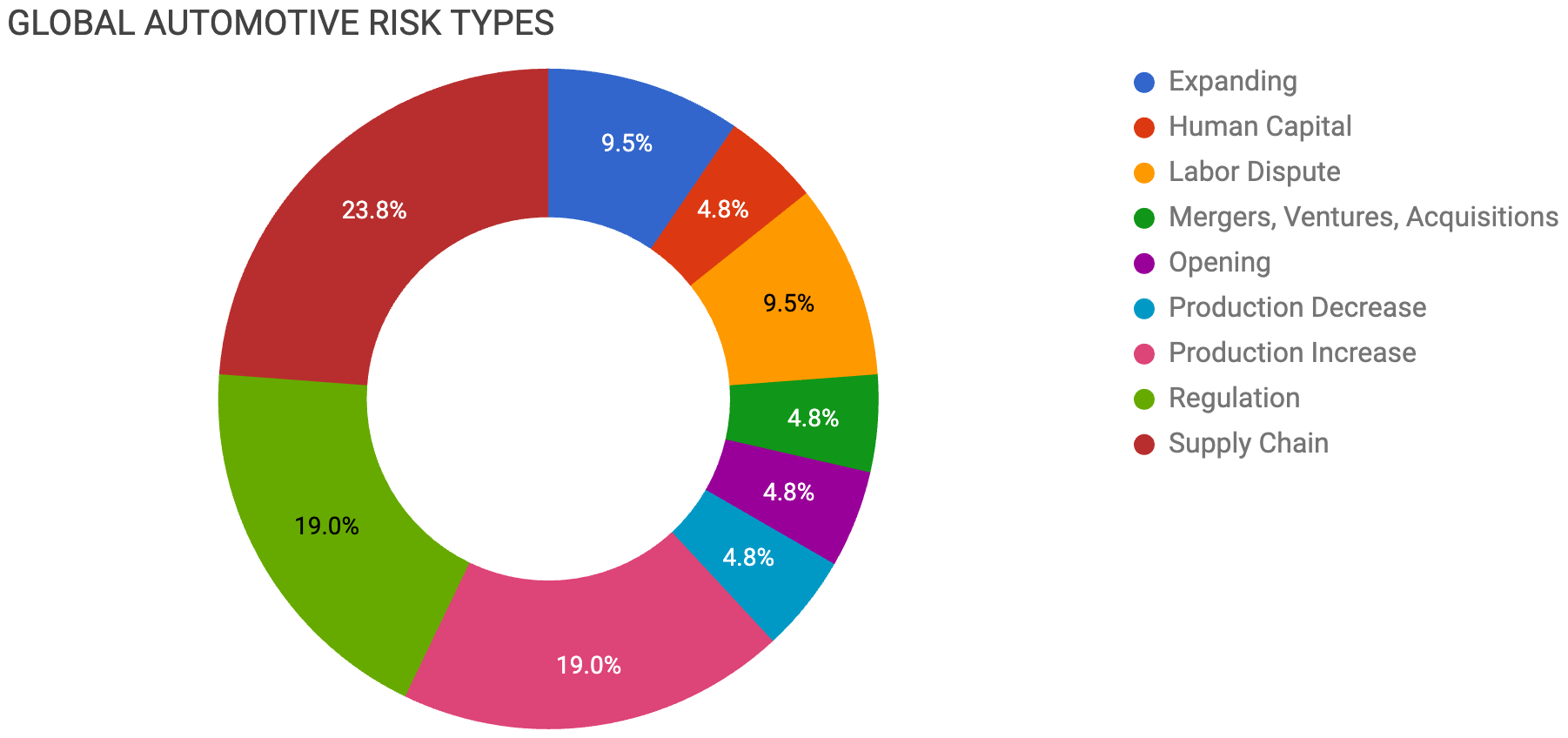
EXPANDING
Honda plans $462M Alabama hybrid and truck expansion
Tesla plans $3.31B Berlin expansion for Cybercab production
HUMAN CAPITAL
Renault plans 2k French factory hires, up to 1k quality, supply chain job cuts
LABOR DISPUTE
IG Metall calls 24-hour German auto and steel strikes
Volkswagen seeks two-year pay freeze and longer hours
MERGERS, VENTURES, ACQUISITIONS
Foxconn plans roughly $45.5M Sony automotive camera deal
OPENING
Nissen Chemitec plans $50M molding plant in Jasper, Alabama
PRODUCTION DECREASE
BMW cuts San Luis Potosí production to one shift
PRODUCTION INCREASE
BMW accelerates Neue Klasse ramp on 100k+ iX3 orders
Ford’s Marshall plant ships LFP cells for Fathom prototypes
Scout begins validation builds in Blythewood, confirms 2028 deliveries
Mercedes-Benz starts volume production of VLE minivans in China
REGULATION
US lawmakers near deal to ban Chinese cars
China to check 17 automakers’ 60-day supplier payment pledges
USTR seeks tighter USMCA origin rules for vehicles
Mexico’s rules for importing new light vehicles
SUPPLY CHAIN
Durban ship-waits reach 20 days, disrupting Metair shipments
Japanese automakers plan shared steel, resin and harness specs
JLR’s cost cuts could bring supplier price-down requests
Lincoln plans Aviator EX8, its first China-developed electrified model
Tesla reports 98% parts localization at Giga Shanghai

Expanding
Honda has put a price on the Alabama part of the expansion it outlined last week alongside its $3B Ohio plant. It will invest $462M at its Lincoln plant to add a line for a new hybrid V6 engine and raise light truck output, and it expects to need about 200 more workers. The plant is the only source worldwide for the Odyssey, Pilot, Passport, and Ridgeline, and it can build 340k vehicles and 340k engines a year. The new line can build several models, giving Honda more flexibility to shift output between models.
Tesla will spend about $3.31B on a new facility at its Berlin-Brandenburg plant to build the Cybercab, its two-door self-driving car with no steering wheel or pedals. Plant chief Andre Thierig said construction will start in the first half of 2027 and output will begin in 2029, with an eventual goal of 1M vehicles a year. The site already builds hundreds of thousands of Model Ys a year and millions of battery cells. [Issue #508 covered the Cybertruck wind-down in Texas to make room for Cybercab.] Berlin gives Cybercab a second plant across the Atlantic, but the 1M/y figure is a target, not a plan with dates.

Human Capital
Renault plans to hire 2k staff at its French plants by 2028 to meet electric vehicle demand, while cutting up to 1k white-collar jobs through voluntary departures. EV sales in Europe have jumped as gas prices soared after the US and Israel attacked Iran. The plan calls for 1.65k blue-collar workers, 250 indirect production staff and 100 graduates. The cuts reach quality control and supply chain roles across Renault's French plants, but not assembly line workers. Talks with unions have just started. The cuts include supply chain and quality staff, so suppliers should expect turnover among their Renault contacts during the voluntary departures.

Labor
IG Metall called 24-hour strikes for Friday, Nov. 20, at hundreds of businesses in the steel, auto and other sectors, escalating a pay dispute that covers 3.7M workers at Audi, Mercedes-Benz, Tata Steel and others. The union wants a 5% raise, job and site protections, and profit sharing in strong sectors. Employers offer a 1% one-off payment in July 2027 and a 1.3% raise from July 2028, which the union calls a real-terms pay cut. In the week the strike was planned, Mercedes said it would halt all investment in its German plants and look at closing sites, and no fourth round of talks has been set.
Volkswagen, which bargains on its own, set out its demands on Nov. 19 for talks covering about 120k workers. VW wants a two-year pay freeze, an end to a bonus paid in cash or extra leave, and the right to require more than a 35-hour week without extra pay. The union’s chief negotiator said the board was stabbing its workers in the back. Talks start Nov. 24 in Emden, home to one of four plants VW could close in the early 2030s, and workers have threatened to strike starting in January. Mercedes has also asked German workers to accept longer hours on the same pay. [Issue #506 covered VW’s termination of its wage agreements.] IG Metall’s regional round and VW’s house talks now run side by side, so German suppliers face strike risk at both customer groups into January.

Mergers, Ventures, Acquisitions
Foxconn will buy Sony Semiconductor Solutions' car camera module business for about $45.5M. The price could still change, since talks on overseas equipment and stock are not done. Foxconn wants the unit’s know-how, customers, and track record of selling straight to carmakers. The deal should close by the end of April if it wins approval. [Issue #505 covered Foxconn’s $728M deal for half of Mitsubishi Electric Mobility.]

Opening
Tier 1 plastic injection molder Nissen Chemitec America will invest $50M in a plant at the Jasper Industrial Park in Walker County, Alabama. It is buying a 44-acre site for a 160k ft² building, and construction starts in the first quarter of 2027.

Production Decrease
BMW has moved its San Luis Potosí plant to a single shift and is cutting about 2% of its staff while it retools for the Neue Klasse in 2027. The plant will add the iX3 and i3 alongside the 2 Series Coupé and M2. BMW also cites tough competition, tariffs, and shifting markets, and calls the cut minimal. The Liga Sindical Obrera Mexicana (LSOM) calls the layoffs illegal, saying BMW did not notify the union or labor authorities. The Confederation of Mexican Workers (CTM) holds the plant's contract, and the LSOM accuses it of failing to defend workers. [Issue #499 covered BMW reaffirming SLP's 2027 Neue Klasse start.]

Production Increase
Elsewhere, BMW is speeding up. More than 100k orders this year for the iX3 built in Debrecen, Hungary, have led it to ramp some plants faster than planned, production chief Raymond Wittmann said. About 90% of the equipment is the same across Neue Klasse sites, so lessons move quickly between vehicle and battery plants. A battery plant in Woodruff, South Carolina, will supply the iX5, and Spartanburg will build at least six electric models by 2030. BMW is also cutting jobs in China, where Wittmann says capacity exceeds demand, through flexible working and cost cuts rather than plant closures. [Issue #507 reported unconfirmed cuts of about 1.8k jobs at Shenyang.] With 90% of Neue Klasse equipment standardized, suppliers already qualified at Debrecen will likely have an edge as San Luis Potosí and Spartanburg tool up.
Ford's $3B battery plant in Marshall, Michigan, has begun shipping lithium iron phosphate (LFP) cells for prototypes of the Fathom, its coming electric pickup. Ford makes the cells under a license from CATL, whose staff are on site to train Ford workers. The 46-acre plant can eventually make 80 cells a minute on two lines. Ford plans to hire up to 800 workers by the end of 2026 and about 1.7k over time, with about 170 prototypes on the road and customer deliveries on track for the fourth quarter of 2027. Republicans in Congress have questioned the CATL tie, and Ford says it owns the site, equipment, and workforce. [Issue #489 reported CATL's statement that Marshall began production in June.] CATL trainers are on site only for a limited time, which puts the skills transfer for a 1.7k workforce on a clock.
Scout Motors has begun validation builds at its $2B plant in Blythewood, South Carolina, and now confirms that first deliveries of the Traveler SUV and Terra pickup will come in 2028. That is two years later than the 2026 start it gave before breaking ground. Validation runs into 2027, followed by pre-production builds. The body shop uses more than 750 robots and is built for about 40 vehicles an hour. Scout expects to need more than 4k workers, and a $300M on-site supplier park should support about 1k supplier jobs. Of more than 160k refundable reservations, 87% are for the range-extender version. [Issue #506 reported AutoForecast Solutions’ projections.] With 87% of reservations for the range extender, engine and generator suppliers matter more to Blythewood’s ramp than the original EV plan suggested.
Mercedes-Benz has started mass production of the VLE electric minivan at Fujian Benz, its joint venture with BAIC and Fujian Motor Industry in China. The van is built alongside the V-Class and Vito, and the plant aims for 60% local content on vans built on the VAN.EA architecture. Batteries come from CATL. Volume production began in Spain in June.

Regulation
Mercedes is also at the center of a US fight. Lawmakers are close to a deal to write a ban on Chinese cars into law before the new Congress starts in January, according to people familiar with the talks. Senator Bernie Moreno briefed automakers this week on changes that would shield Mercedes, which is nearly 20% owned by Chinese entities, including almost 10% by state-owned BAIC. An earlier Senate bill would have barred makers more than 15% Chinese-owned from selling cars with technology that can send data. Automakers broadly back the effort, but a Mercedes official raised concerns, and details are still open. [The Volvo question from Issue #501 stays open if relief is written around Mercedes alone.]
China will now check whether 17 major automakers, including BYD, Nio and Xiaomi, keep their pledge to pay suppliers within 60 days. The China Association of Automobile Manufacturers (CAAM) will do the checks for the Ministry of Industry and Information Technology (MIIT) and publish annual results. Automakers must report on 2026 and fourth-quarter payments by Jan. 31, 2027, and CAAM will visit at least 15 suppliers per automaker each year to check the data. Small and medium suppliers must be paid within 60 days, and larger ones must get at least 80% in cash or bank acceptance bills. Contracts must run for at least a year, and MIIT will summon automakers with large payables or many complaints. [Issue #499 covered the September rules.] The 80% floor on cash and bank bills for larger suppliers is the provision to read closely, since it limits how much of a payment can arrive as commercial paper.
USTR wants tighter rules of origin in the USMCA review, saying the current rules have let US content in cars built in Mexico and Canada shrink. It has proposed caps or penalties on electronics sourced outside North America. Mexico’s automakers are already shifting exports. The US share of Mexican light-vehicle exports fell to 75.9% from 79.3% in January to July, while shipments to Canada, Germany and Brazil jumped. US purchases of Mexican vehicles and parts fell $4.87B in the first quarter. Mexico is tying investments such as Kia’s $649M at Pesquería to local content goals, and Kia’s new car will start at 27% Mexican content. Officials say it takes three to four years to build Tier 1 and Tier 2 capacity. A cap on non-North American chips, circuit boards, and displays would hit electronics suppliers first, which are already short on capacity [Issue #508].
Resource: Mexico Business News - Customs, NOM Compliance Govern Light-Vehicle Imports in Mexico
A guide to the customs and safety rules for bringing new light vehicles into Mexico. Useful for teams that ship built vehicles into Mexico. It lists the agencies involved, what counts as a new vehicle at the border, and the NOM-194 safety schedule. That schedule adds tire pressure monitors and high-voltage protection for 2026 models and pole side-impact protection for 2027. It also flags that CO2 fleet rules under NOM-163 may get tighter.

Supply Chain
Ships are waiting 14 to 20 days at Durban Gateway Terminal, South Africa’s largest container terminal, and parts maker Metair says it may have to invoke force majeure. The backlog worsened after a mid-August switch to a new terminal operating system, and throughput first fell about 26% to 30%. Metair, which supplies Toyota, Ford, Volkswagen and Isuzu, has turned to air freight and overtime, and one customer’s line stopped for a time. It expects the extra cost to equal 20% to 25% of last year’s EBITDA. The transport minister expects new equipment in December and a gradual recovery through February 2027. Metair doesn’t expect real relief before the first quarter of 2027, so buyers of South African parts should plan for longer transit and premium freight through year-end.
Japan’s carmakers will set common specs for steel, resin and wire harnesses, the first parts in a push to cut costs by competing less with each other. Toyota, Nissan, Honda, Mazda, Subaru, Mitsubishi and Suzuki agreed on the three areas on Nov. 19 through the Japan Automobile Manufacturers Association (JAMA). Work starts in 2027, though there is no full timeline. They will share steel quality tests, set common rules for recycling resin, and cut about 70k harness variants. They also plan common harness color codes, more harness automation, and a shift from copper to aluminum wire. Talks start with Japanese suppliers and will widen to overseas ones. Fewer harness variants are what make automation pay, so the change favors harness makers that can fund automated lines.
Cost pressure is also driving JLR. The Tata Motors unit will cut about $2.3B in costs over two years across manufacturing, materials, logistics and warranty, aiming to bring its cash break-even down to about 300k vehicles. It cut its fiscal 2027 margin forecast to 2% to 3% from about 4% and expects a free cash outflow of about $1.65B. A one-off charge of about $700M includes $390M for voluntary redundancy covering about 4k people. Its China volumes fell sharply in a market down almost 30%, while North American wholesale volumes rose 20% in the first half. Materials and logistics are named targets of the cost drive, so suppliers should expect price-down requests in a year when JLR is burning cash.
Western brands are turning to China’s supply base too. Lincoln will launch the Aviator EX8, its first China-developed electrified model, in the first half of 2027. Changan-Ford will build the plug-in hybrid in Chongqing, with a 1.5-liter engine from Changan and LFP batteries from CATL. Lincoln’s China sales fell 41% to about 17k in the first three quarters as high oil prices hurt demand for gas models. None of its five China-built models was developed there, and only the Corsair offers a hybrid.
Tesla says parts localization at Giga Shanghai has reached 98%, up from over 95%. It works with more than 400 local Tier 1 suppliers, and more than 60 now supply Tesla’s global network. Elon Musk, visiting Shenzhen this week, said Tesla will keep raising output in China. Shanghai delivered 810.9k vehicles in the first 10 months, up 21%, as exports doubled to 421k while China retail sales fell 15%. In October, exports made up a record 87% of Shanghai’s wholesale volume. Exports now carry Shanghai’s volume, so its suppliers’ utilization depends more on trade decisions abroad than on Chinese demand.