Contents
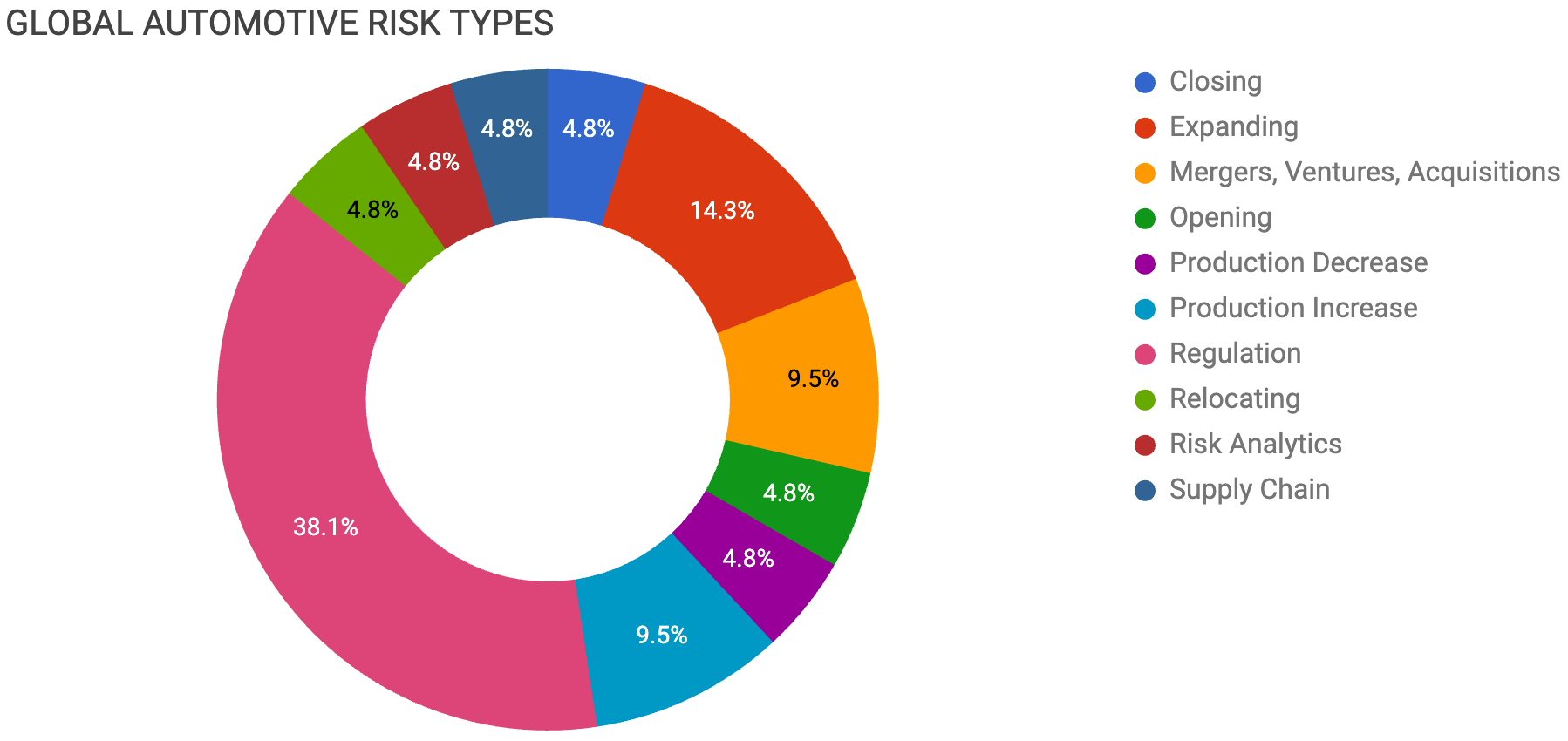
CLOSING
Lear closing Michigan molding plant
EXPANDING
Hyundai doubling Talegaon production capacity
Stellantis expanding India investment and launches
GlobalFoundries adding two New York fabs
MERGERS, VENTURES, ACQUISITIONS
Changan CATL venture expands to 75 GWh
Seres adds captive CATL battery capacity
OPENING
Yura will open its first Southeast US wiring site
PRODUCTION DECREASE
Volvo EX60 production badly trails plan
PRODUCTION INCREASE
Leapmotor B10 enters Spanish production
GM launches Silverado Sierra in Silao
REGULATION
Assembly parts gain five-year duty relief in Mexico
Mexico pushes new US trade deal
USMCA uncertainty delays major investments
China agrees to curb EU hybrids at 350k
Chinese automakers accelerate European localization
Britain resists Chinese vehicle tariffs
China cuts NEV export rebates
RELOCATING
Audi plans A8 production in Leipzig
RISK ANALYTICS
China competition becomes system-level battle
SUPPLY CHAIN
Shippers divert cargo toward Los Angeles from Panama Canal

Closing
Lear will close its molding plant in Sterling Heights, Michigan, in July 2027. The site has 67 workers. Lear bought it in 2021 from M&N Plastics, which makes plastic parts for electrical systems, and blames market conditions for the decision. Lear hasn’t said where the Sterling Heights work goes. Workers can move to Lear's new plant in Orion, Michigan, which Lear is building around advanced automation. It has already run a lights-out shift on 12 automated molding machines at its connector plant in Wismar, Germany.

Expanding
Hyundai will increase capacity at its Talegaon plant near Pune (the former General Motors plant) from 170k to 320k cars a year by 2030. With Chennai, that gives it about 1.14M units of capacity in India. Hyundai has invested about $730M in Maharashtra and plans to invest an additional $420M. Its 55 suppliers there have invested about $480M and employ more than 18k people, including Tier 2 vendors. Hyundai wants 92% local content, up from 83%. Its parent group plans to spend $15.5B in India over seven years.
Stellantis is making a smaller bet on the same market. It will put about $420M more into India, for a total of about $1.57B by 2030, and plans 12 Jeep and Citroën launches by 2029. It targets 90% local content, built on its plants in Ranjangaon, Thiruvallur and Hosur. Hosur ships about 95% of its engines and gearboxes abroad. That makes Stellantis’s India suppliers part of programs that reach well beyond India.
GlobalFoundries will build and run two new 300mm chip fabs at its Malta, New York, site. Japan will fund up to $21B under a US-Japan trade deal. About $10B goes to the first fab, which breaks ground this year and opens in 2029. Each fab adds about 900k wafers a year, and the project will need more than 1k skilled workers. Renesas, a major maker of automotive microcontrollers, sees the new fabs as part of its own footprint. GlobalFoundries is also shifting $955M of its CHIPS Act award to silicon photonics, silicon-germanium and advanced packaging in Malta and Burlington, Vermont. First output is 2029, so this adds little near-term chip relief.

Mergers, Ventures, Acquisitions
CATL is tying more of its new capacity to single automakers. Changan and CATL will grow their battery joint venture to 75 GWh from a planned 50 GWh, and will work together on solid-state and sodium-ion cells. The extra 25 GWh comes from a new site near Chongqing, covering about 173 acres and costing about $740M. It starts in 2027, hits full output in three years, and will need about 2.5k workers. The venture will produce cells for Changan's Avatr, Deepal, and Nevo brands. Cheaper cells could also help Changan, which earns only about $10 a car, according to ZAKER News.
Seres is taking the same route, also in Chongqing. It signed a long-term deal with CATL to accelerate the second phase of its plant-in-plant battery project at the Seres factory, adding 10 to 12 GWh per year. The site’s total capacity will top 20 GWh. CATL began building cell-to-pack battery systems there in June 2025, and has supplied every Aito model since the brand launched. Neither company said how long the deal runs or when phase two will start. Captive capacity like this leaves rival cell makers few open bids at Changan or Seres.

Opening
Wiring supplier Yura Corporation will spend $5M to open its first site in the Southeast US, in Bloomingdale, Georgia. It expects a staff of 55. The site will ship wiring harnesses and electronic modules to Hyundai Motor Group’s Metaplant. It will start as a warehouse, with production to come later. HMGMA's harnesses are still built elsewhere, and Yura gave no date for local production.

Production Decrease
Volvo Cars is far behind plan on its EX60 electric crossover at Torslanda, Sweden. Output since the April start is about a tenth of its 2k-a-week goal, according to a person who knows the matter. The trouble lies in fitting the battery to the body and in making the electric motors. The EX60 is Volvo's first car with megacasting and cell-to-body design, and joining the battery to the cast frame has proved harder than planned. Europe gets cars first. US dealers should not expect real volume until the second half of 2027, and Volvo has cut its 2026 volume and cash-flow outlook.

Production Increase
Leapmotor's B10 small SUV is now in full production at Stellantis' plant in Zaragoza, Spain (pre-production was covered in Issue #500). It is the Chinese brand's second attempt to build in Europe. Stellantis ended the first, in Poland, in March 2025. Stellantis also plans a Zaragoza line for a new Opel electric SUV in 2028.
Another launch began this week in Mexico. GM has started building the new Chevrolet Silverado and GMC Sierra at Silao, beginning with Crew Cab models, according to sources at GM Authority. Silao will be the only source through year-end. It will add regular cabs on Feb. 8. Fort Wayne, Indiana, will start in early 2027, with Double Cabs starting April 12. Oshawa, Ontario, is not in the plan, though GM has not confirmed it (Issues #495 and #498 flagged Oshawa losing the light-duty truck). Supply chain director Noel Vaquera says the first plant takes the launch pain, from late part approvals to parts that don’t fit. Every new Silverado and Sierra comes from Mexico through year-end, so the US-Mexico tariff talks land on GM’s biggest launch.

Regulation
Mexico has dropped its 10% duty on car parts brought in for assembly for five years, starting Oct. 14. The relief is narrow. Only automakers with bonded fiscal warehouses qualify under tariff code 9803.00.01, and it doesn’t cover suppliers or finished cars. But it applies to parts from any country. The goal is to draw kit assembly, in semi- or fully knocked-down form, as a first step to full plants. New investment has stalled, with Nissan’s CIVAC plant shut and Toyota cutting back in Tijuana. The relief targets the paused Chinese assembly projects Issue #503 reported, and kits keep imports high at first. Mexican Tier 2 and Tier 3 suppliers benefit only if those projects move beyond kits.
Mexico is also pushing for a trade deal with Washington. President Claudia Sheinbaum says Mexico is buying more US goods and less from other countries. The goal is to shrink a surplus that grew 51% to more than $280B through August. Autos are still the main gap. Mexico wants duties only on the part of a car’s value made outside North America. The US wants 50% US-made parts for lower rates, a bar Mexico and the industry call impractical. Mexico’s pledge to buy less from third countries sits oddly with the duty-free parts window it opened to all countries the same week.
Firm answers are unlikely before the Nov. 3 midterms. The USMCA stays in force but is now caught in an annual review cycle until it is extended or ends in 2036. Analysts say uncertainty is holding back major investments. Talks with Mexico will likely focus on sector tariffs, with rules of origin pushed into 2027. Canada faces a Jan. 1 threat to double US tariffs on its cars and parts to 50%. More duties may follow the vote, including those from a US probe into excess capacity in China, the EU, Japan, South Korea and Mexico, and possible tariffs on robots, machinery and more chips. Parts outside the auto tariffs, such as many nonmetal parts, electronics and interior materials, already pay 10% to 12.5% duties set in July, and new duties could stack on top. Those lines are the place to check exposure first.
China has agreed to curb hybrid exports to the EU, its fastest-growing way into Europe. Those exports tripled to $7.5B in the first half. The EU's 2024 tariffs on Chinese EVs pushed automakers to plug-in hybrids, which escaped the extra duties. SAIC, BYD, and Chery account for more than 90% of the volume. Analysts expect the curbs to push more Chinese brands to build in Europe, though smaller ones may lack the cash.
The cap is 350k hybrids a year, likely starting in early December, rising 6% annually for four years. As a safeguard, it also covers the EU's other trade partners. Chinese hybrid exports to the EU are on track for 800k this year, and the cap should cut the share of Chinese-built cars to about 6% from 12%. In December, the European Commission plans a tool to limit how much firms rely on a single source for some critical supplies. Issue #500 noted that a quota hits allocation and lead time, not landed cost. Since the cap covers all trade partners, that planning problem may reach other hybrid importers too once quota details are out.
Chinese automakers are not waiting for the EU’s Made in Europe local-content rules. Changan wants to build its first car in Europe in the first half of 2027, reach 180k a year by 2028, and 350k by 2030. Xpeng, Chery, and GAC also plan European plants with local suppliers, and Magna already builds Xpengs in Austria. The open question is what counts as Europe. The draft covers only EU members. It excludes Turkey, the UK, and Morocco, whose suppliers are closely tied to EU plants. For Tier 1s in those three countries, the definition of Europe now decides whether their content counts.
Britain is holding its line. Business Secretary Jonathan Reynolds says UK tariff choices rest on UK interests, not EU requests. He denies Britain is a back door to the EU, since no major Chinese automaker builds cars there. UK makers fear being shut out of Made in Europe supply chains. Officials hope to shape the rules at the UK-EU summit in Brussels on Nov. 20.
Chinese exporters also face a squeeze at home. On April 1, 2027, China will cut its export VAT rebate on new energy vehicles (NEVs) to 9% from 13%. The cut covers battery electric and plug-in hybrid cars, plus electric buses and truck tractors. Deutsche Bank says the cut will reduce BYD’s net profit by about $743 for each car it exports. Exports now carry the industry. NEV exports rose 130% to 4.0M in the first nine months, while home sales fell 9.4% in September. The battery rebate, cut to 6% in April, ends on Jan. 1, 2027. Buyers of Chinese cells should check whether their contracts let suppliers pass the lost rebate on.

Relocating
Audi plans to build the next A8 at Porsche’s Leipzig plant, German media report. Output would start in 2030 at the earliest, on a platform shared with the next Panamera. That likely takes an anchor away from Audi’s Neckarsulm plant in Baden-Württemberg, where more than 15k people work. Neckarsulm and VW’s Emden, Hanover and Zwickau plants face staged closure from 2031 unless new uses are found. Audi, already set to cut 7.5k jobs by 2029, is reopening labor talks because agreed savings fall short. (Issue #493 covered the end of A8 output and the night-shift cut at Neckarsulm. Neckarsulm, which also builds the A5 and A6, has no confirmed program after those.)

Risk Analytics
Mobility Global: New Order: China, the West, and the Battle for Automotive Advantage
AlixPartners: Can Europe still build cars into the 2030s? Yes, but only those companies willing to make tough decisions

Supply Chain
Shippers are moving cargo away from the Panama and Suez canals and toward Los Angeles. The port handled a record 1.04M twenty-foot equivalent units (TEUs) in September, and port director Gene Seroka says about 5% more cargo is now booked to LA at origin. Drought rules have cut Panama Canal capacity. From January to late September, 69 container ships waited more than 100 hours to cross, against 13 a year earlier. El Niño should peak by December, followed by the 2027 dry season. Seroka says ship fuel costs have doubled in eight months due to the Iran war. He expects another rush of early shipments before an early Lunar New Year and the Jan. 10 end of the US-China trade truce. For parts, Jan. 10 is the date to plan around (previously in Issue #501), and the rush can tighten West Coast capacity this winter.