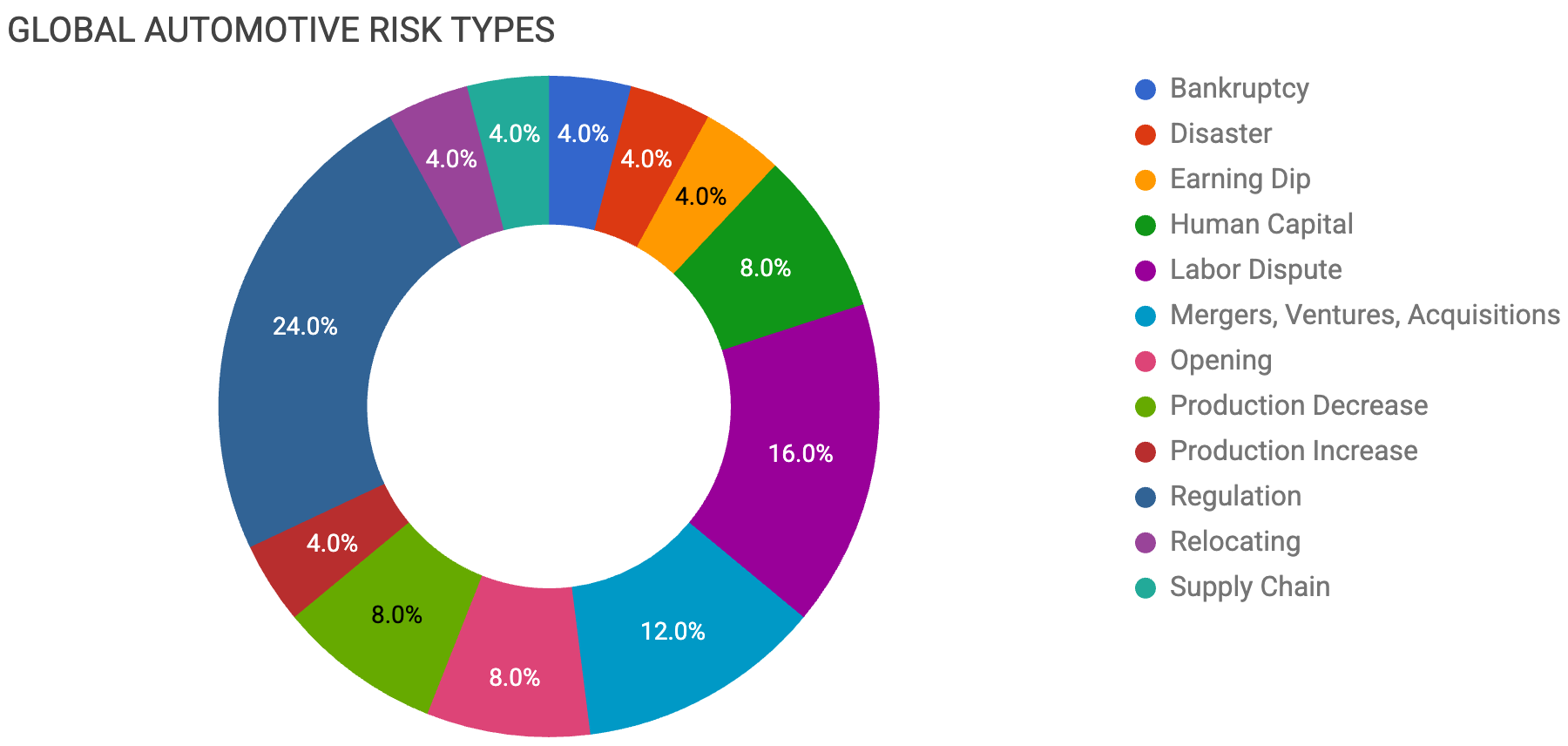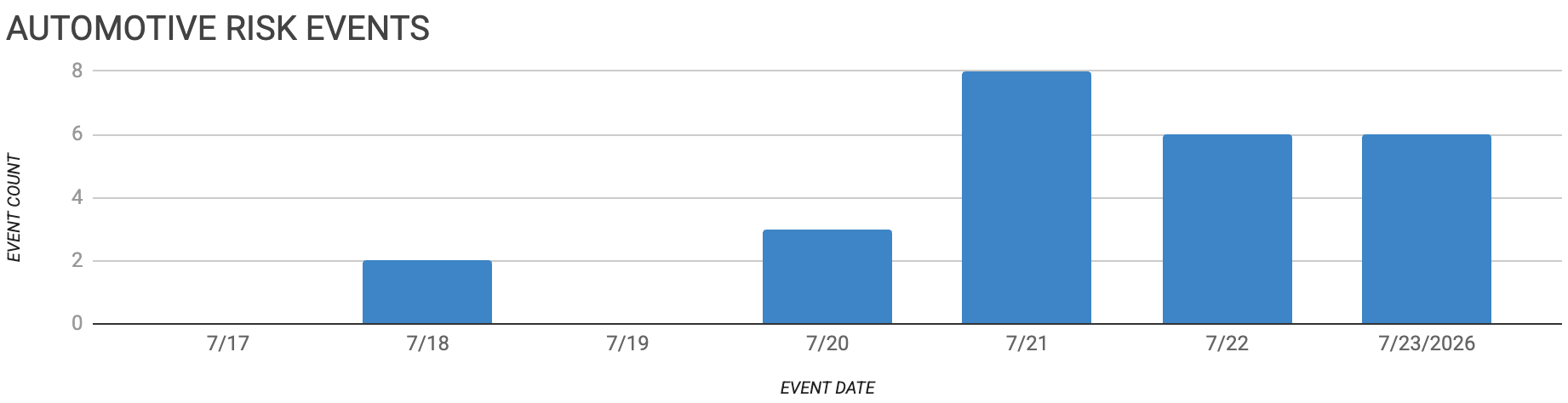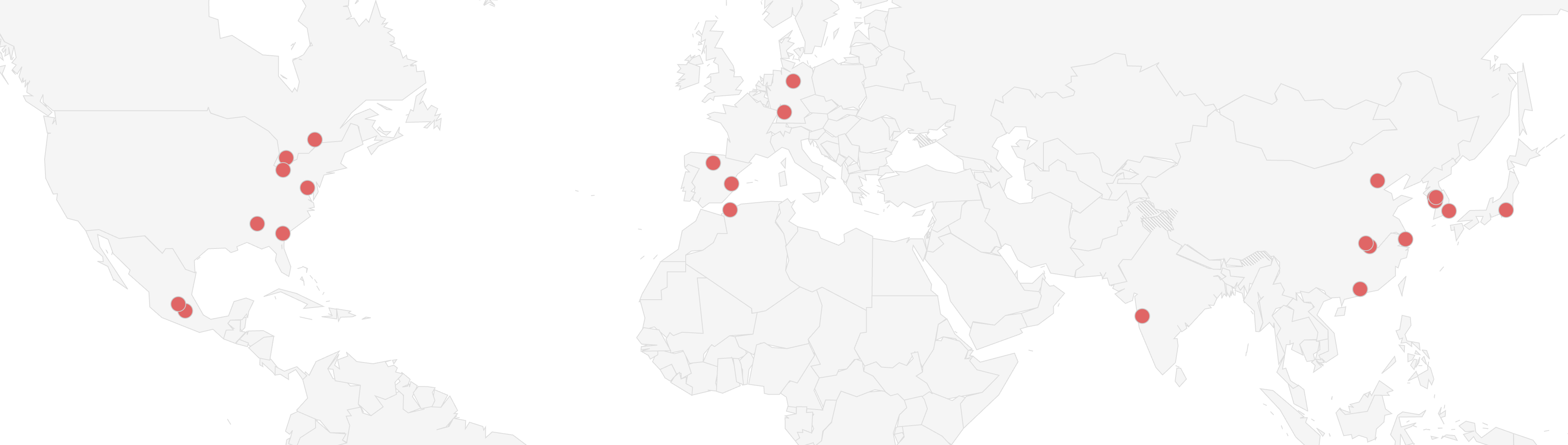
Contents
BANKRUPTCY
Grupo Antolin gains US bankruptcy protection
DISASTER
HL Mando inspection death triggers shutdown
EARNING DIP
Hyundai profits fall despite record revenue
HUMAN CAPITAL
Porsche German workforce cuts expand to 8.9k
BYD launches export-driven 9k hiring expansion
LABOR DISPUTE
Hyundai workers intensify Ulsan strikes
Atlas robot plans complicate negotiations
GM Korea workers continue partial strikes
Unifor talks driven by GM product commitments
MERGERS, VENTURES, ACQUISITIONS
Ford and Geely partner in Spain
Honda extends GAC venture through 2038
Volkswagen considers JSW India investment
OPENING
NetShape opens second Queretaro plant
Opel plans Algerian vehicle production
PRODUCTION DECREASE
German Volkswagen programs face relocation risk
Honda pauses Ridgeline production until 2028
PRODUCTION INCREASE
SVOLT begins Hubei battery pack production
REGULATION
US introduces new Section 301 tariffs
Mexico resumes USMCA talks with US
Canadian suppliers face August tariff deadline
Senate advances Chinese ownership restrictions
Connected-vehicle restrictions force resourcing
“Ownership %” is the new “rules of origin”
RELOCATING
Honda considers another North American plant
SUPPLY CHAIN
CALB battery defects force extended warranties

Bankruptcy
Grupo Antolin filed for Chapter 15 protection in New York to shield its US assets while a Spanish restructuring moves toward a court hearing in September or October. The interiors, lighting and exterior plastics supplier said it could not meet upcoming debt maturities after 2025 sales fell 11% to $4.2B, with more than one-third of revenue from North America. Ford, GM, Stellantis, Volkswagen and Nissan are major customers. Bondholders holding 67.2% of its senior secured notes are challenging a plan that would leave family ownership intact while offering some creditors better terms.

Disaster
A contract repair worker in his 20s died at HL Mando's plant in Poseung-eup, Pyeongtaek, South Korea, after being caught in a block processing tank that someone activated during an inspection. The Ministry of Employment and Labour has issued a stop-work order at the site and is weighing charges under the Serious Accident Punishment Act. At the same time, Gyeonggi police have opened a serious disaster investigation. HL Mando is a Tier 1 brake, steering and suspension supplier, so a prolonged stop-work order reaches multiple OEM programs.

Earning Dip
Hyundai Motor’s second-quarter net profit fell 11% to $1.96B as global vehicle sales dropped 6.9% and operating profit fell 21%. Wholesale sales fell 16% in South Korea and 11% in Europe, while fires at contract component suppliers also disrupted domestic output. The earnings pressure is landing alongside a second week of partial strikes, adding labor risk to weaker demand and higher material costs. (more ↓)

Human Capital
Porsche approved another 5k job cuts in Germany, lifting planned reductions to 8.9k, or roughly 39% of its 23k German workforce. The cuts will focus on administrative and engineering roles, with the 7.5k-worker Weissach development center expected to be hit hard. Deliveries are forecast to fall to about 250k this year from 320k in 2023, and Porsche wants to lower its break-even point to 180k vehicles. The October production-allocation review will be important for suppliers tied to higher-cost German plants, including Zuffenhausen.
Meanwhile, BYD is recruiting more than 9k workers at its Shenshan industrial base, including 4.8k at one Xiaomo division, 1.2k at another and 2k at the Ebu components plant. The site produced more than 300k vehicles last year and builds export models including the Song Plus and Song Pro. Hiring follows a 70% jump in first-half overseas sales to about 789k vehicles, with BYD targeting 1.5M for 2026.

Labor
Hyundai Motor's union struck for four hours per shift from July 20 to 22, double the previous week's two hours, halting Ulsan production for up to eight hours a day once both shifts are counted. The union, which represents more than 40k workers, is also refusing overtime and weekend work. Talks are stuck on pay, with the company offering a monthly base increase of about $60 plus a bonus of 350% of base pay and roughly $6.8k in cash, against union demands of about $102 a month, an 800% bonus and a share equal to 30% of last year's net profit.
The dispute also carries an automation subtext that Hyundai is working to keep off the table. The company says its planned 2028 rollout of Atlas humanoid robots applies only to Metaplant America near Savannah, Georgia, and is not part of Korean bargaining, while the union has told management that no new-technology robot enters a plant without an agreement. The two sides are separately reviewing a wage overhaul that would convert overtime and night-shift allowances into fixed pay, giving workers more income stability if automation cuts hours. Hyundai owns Boston Dynamics outright and wants a plant capable of building 30k robots a year, so this is a recurring bargaining item rather than a one-off.
GM Korea's union is in the same fight, striking four hours across all shifts on July 21 and 22 in its second week of action. Workers want a monthly base increase of about $100, an annual bonus of roughly $20.2k, and a commitment to build new models at the company's Korean plants. GM Korea shipped 276k vehicles globally in the first half, up 10.5%, with exports up 12% to 270k units and headed mostly to the US, and it is targeting 500k units of production this year against 462k in 2025. With nearly all output going to the US, a longer walkout shows up in US inventory before it shows up in Korea.
Unifor will open contract talks with General Motors in Toronto on August 10, carrying a pattern set by a just-ratified Ford deal with 3% annual raises over three years. The union represents more than 4.6k GM workers in Ontario at Oshawa assembly, the CAMI plant in Ingersoll, St. Catharines and Woodstock. Unifor president Lana Payne expects harder bargaining than at Ford, since GM's Ingersoll plant and Stellantis's Brampton plant both sit idle with thousands laid off. Idle capacity is the union's weakest point, so product commitments rather than wages are the likely flashpoint.

Mergers, Ventures, Acquisitions
Ford and Geely will form a Europe-focused joint venture in the first half of 2027, with Ford holding 66% and Geely 34%, to share the Valencia plant in Spain. Ford will continue building the Kuga there and add its Bronco SUV from 2028; Geely will build two electric SUVs at the site starting the same year, and the two will jointly develop a crossover designed by Ford. Ford framed the deal as a way to pool volume and cut per-vehicle cost, with backing from Spain's national and regional governments. This follows Stellantis deals with Leapmotor in Spain and Dongfeng at Rennes, and it points to a European supply base that increasingly serves Chinese platforms alongside Western ones.
Honda extended its GAC Honda joint venture through 2038, two years before the current contract expires, despite a collapse in China volume. Honda's China sales fell to 645k vehicles in 2025 from a 1.63M peak in 2020, and first-half 2026 deliveries dropped 35% to 206k, with GAC Honda down 46% to under 90k. Honda says it will rebuild using locally sourced standard components, local next-generation technology, and new energy vehicles built on platforms supplied by its Chinese partners. That last point is the one incumbent Japanese and Western suppliers in China should read closely, since a shift to local standard components likely moves sourcing authority to the partner.
Volkswagen is in advanced talks to sell a stake in Skoda Auto Volkswagen India to the JSW conglomerate, per a Bloomberg report, with a deal possible within weeks. The capital would go to the unit running Volkswagen's Indian operations, which the group is leaning on for growth after exiting Russia and pulling back in China. A local industrial partner would bring pressure to raise Indian content, worth watching for suppliers currently shipping into the group's Indian plants.

Opening
NetShape Mexico, a subsidiary of US supplier Shape Corp., opened a $13.6M plant at the FINSA Industrial Park in Queretaro, adding more than 260 jobs. The site builds structural components for modern vehicle architectures and follows the company's first Queretaro plant, which opened in 2010. Queretaro is still drawing structural work even with USMCA rules of origin under renegotiation, which suggests suppliers are betting the regional content math continues to favor Mexico.
Opel signed a memorandum of understanding with Algeria's AGM Holding on July 17 to build vehicles and engines in the country, which would make it the first automaker to manufacture engines in Algeria. The company says the site is planned as a full plant with body, paint and final assembly rather than a knocked-down operation. However, it disclosed no investment figure, capacity or timeline. Stellantis already builds Fiat models at Tafraoui, where it aims to lift output to 135k vehicles by 2028 from 53k in 2025, and is doubling capacity in Kenitra, Morocco. Output is aimed at Algerian customers rather than exports, so this adds capacity in North Africa without relieving the overcapacity Stellantis is carrying in Europe.

Production Decrease
Volkswagen will allocate future models to plants based on manufacturing cost rather than brand, production chief Christian Vollmer said in an internal interview, with decisions made jointly with the finance department. The group is targeting factory costs of about $3.5k per vehicle and sits roughly $1.2k above that, even after cutting German plant costs by more than 20% last year. Skoda's Czech sites already meet the target, with Kvasiny about a third below it, while Zwickau is approaching $4.6k per vehicle and Hanover runs into five figures. Volkswagen is planning for annual demand near 9M vehicles against pre-pandemic capacity of about 12M, has already removed 2M units, and is taking out another 500k in China with comparable cuts planned for Europe. The next-generation ID4 potentially moving from Emden to the Czech Republic is the test case, and any supplier tooled to a German site should assume its program is up for review.
Honda confirmed on July 23 that it will stop building the Ridgeline at its Lincoln, Alabama, plant later this year and restart in the third quarter of 2028, a hiatus driven by US emissions rules. The next truck will share revised components with the Passport and use an updated 3.5-liter V-6 to comply. Honda is separately developing a large-vehicle hybrid architecture with a new V-6, multiple motors and a lower-cost battery pack for the Ridgeline, Passport, Pilot and Odyssey in the early 2030s. A multi-year gap on one line means Ridgeline-specific tooling and Tier 2 volume at Lincoln go idle well before the replacement program funds anything.

Production Increase
SVOLT Energy started mass production at its battery pack plant in Daye, Hubei, on July 20, five months after breaking ground in February. The site runs two module lines and one pack line and is projected to reach roughly $295M in annual output value, supplying nearby GWM plants building the Gaoshan in Daye and the Tank in Jingmen.

Regulation
The US will impose tariffs of 10% to 12.5% on goods from more than 80 countries starting today at noon, replacing the flat 10% duty that lapses the same day. The new duties run under Section 301 and are tied to how countries enforce bans on forced-labor goods, with Canada and the EU both set at 10%. Oil, gas, certain natural resources, goods qualifying under USMCA, and items already covered by Section 232 tariffs on vehicles and steel are exempt. For auto importers, the immediate change is narrow given those carve-outs, but a further Section 301 action covering 15 countries and the EU over manufacturing practices is still under investigation.
US and Mexican negotiators opened a third round of bilateral USMCA talks in Mexico City on July 21, the first formal discussions since Washington declined to extend the pact on July 1 and started a 10-year wind-down clock. The agenda covers autos, steel, aluminum, agriculture and labor, and it still includes a US proposal from May requiring 50% of the value of a North American-built vehicle to originate in the United States. Trade representative Jamieson Greer cited Toyota's Texas expansion and General Motors' $1.5B in costs to move production north as the outcomes the administration wants. Blocking Chinese back-door access is also on the table, and Chinese brands took 17% of the Mexican car market in the first half, up from 14%, despite 50% tariffs imposed in January.
Canada is on a separate and slower track. Prime Minister Mark Carney said he and President Trump agreed to accelerate talks ahead of a 50% tariff due August 19 on about $20B of Canadian exports, roughly 5% of what Canada ships to the US. That levy would break the pattern under which USMCA-compliant Canadian goods have largely escaped duties, and Carney says Ottawa concedes nothing until the US eases existing sector tariffs of up to 50% on vehicles, metals and forest products. US officials describe the Canadian track as stalled, so anyone with Canadian content should plan for the August date to hold rather than slip.

The Senate Commerce Committee approved a bill on July 22 that would codify and tighten the US ban on Chinese-linked automakers, including a provision barring any company more than 15% owned by Chinese entities. That threshold would capture Mercedes-Benz, which carries close to 20% passive Chinese investment, though the bill allows until 2030 to comply, plus waivers, and committee chair Ted Cruz said it needs changes before it can become law. Cruz also said a battery sourcing provision in the bill would add $5k to vehicle cost. Ownership percentage rather than component origin is a new kind of test, and it pulls equity structure into compliance scope for anyone selling into the US.
The compliance work is already reshaping sourcing. The current rule bans Chinese connected-vehicle software starting with model year 2027 and Chinese connectivity hardware starting with model year 2030. That hardware includes cellular IoT modules, satellite communications, external antennas, and microcontrollers. Because development cycles are long, suppliers need to be locked in now. Eagle Wireless in Solon, Ohio, formed in late 2025 to fill the gap, is growing from 140 employees toward 1k and targeting an annual run rate of 2M modules by the end of the third quarter, with revenue roughly doubling to nearly $100M this year. Non-Chinese modules run a 5% to 15% price premium; most ADAS hardware, including LiDAR, is not covered yet, and Eagle still builds on licensed Quectel designs it must replace before 2030, the same dependency pattern as Ford licensing CATL battery technology for US production. Chinese vendors still ship close to half the world's automotive cellular IoT modules, so the audit burden lands hardest at Tier 2 and below.
China will apply a 2% consumption tax to lithium-ion and other mature battery products from September 1, 2026, rising to 4% a year later, while sodium-ion and solid-state batteries stay exempt through 2028. Batteries a company produces for its own continued production are exempt, and tax paid on purchased cells can be deducted, so automakers that build their own cells avoid the cost and those that buy absorb it. CPCA secretary-general Cui Dongshu puts the impact at roughly 0.007 to 0.008 yuan per Wh, small per vehicle but tens of millions of dollars a year for an automaker building 1M units. The design is a straight subsidy to vertical integration, and it favors BYD, Svolt-backed GWM and Geely against anyone sourcing cells externally, foreign automakers in China included.

Relocating
Honda is considering an eighth North American assembly plant as a production buffer, CEO Toshihiro Mibe told Yomiuri Shimbun on July 18, two months after the company indefinitely suspended its $15B EV supply chain plan in Canada. Honda's North American plants run near 90% utilization, and analysts expect any new site to land in the US if tariffs on Canadian and Mexican vehicles persist. About 75% of the 400k vehicles Honda builds in Canada each year go to the US, and its Alliston plants employ more than 4k people building the CR-V, Civic and four-cylinder engines. A US plant would not immediately displace Alliston, but it would put Canadian output into competition for future product, which is how Detroit Three capacity decisions have played out.

Supply Chain
CALB's 177-Ah lithium iron phosphate cells are at the center of a quality controversy in China after GAC Aion's Aion S recorded a wave of swelling, leakage and insulation failures, flagged by Xinhua on July 14. Third-party inspections attributed the faults to internal manufacturing defects, and failures cluster between 150k and 300k km, just past the point where commercial fleet vehicles leave warranty. GAC Aion extended coverage on affected commercial vehicles from 8 years or 150k km to 8 years or 300k km with free inspection, repair, or pack replacement, and CALB has committed to lifecycle responsibility and direct service. A repair engineer quoted by Xinhua blamed compressed validation cycles driven by market-share pressure at a supplier that installed 23.8 GWh in the first five months of 2026, up 36.3%. That is the same failure mode behind Vremt's $341M claim against Sunwoda and Zeekr's recall of 38k vehicles, and it argues for asking second-source cell suppliers about validation timelines rather than just capacity.