Contents
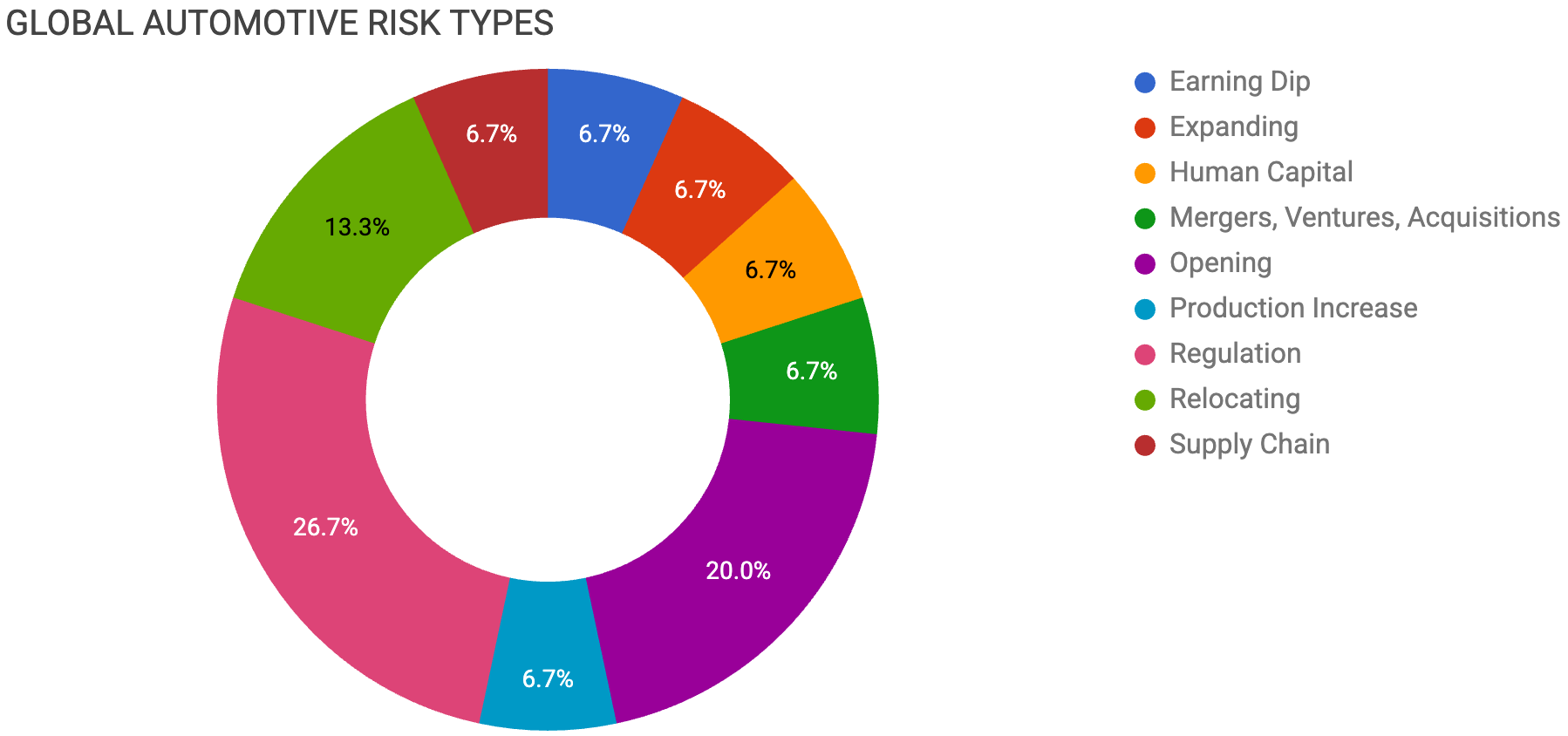
EARNING DIP
Aston Martin creditors coordinate amid distress
EXPANDING
Marquardt expands Tunisian manufacturing capacity
HUMAN CAPITAL
Volkswagen weighs closures and job cuts
MERGERS, VENTURES, ACQUISITIONS
Continental sells ContiTech to Lone Star PE
OPENING
Infineon opens expanded Dresden chip fab
Chery inaugurates ex-Nissan South African assembly plant
KTH plans Texas structural-parts plant
PRODUCTION INCREASE
AESC begins BMW battery cell production
REGULATION
USMCA enters uncertain annual review cycle
Ford seeks production-weighted trade rules
Policy uncertainty stalls Mexican assembly investment
Senate advances Chinese vehicle restrictions
RELOCATING
Toyota shifts Tacoma production to Texas
Mexico faces widening production migration risks
SUPPLY CHAIN
Morocco sustains Renault export competitiveness

Earning Dip
A group of Aston Martin creditors holding more than half of the company's secured notes has signed a cooperation pact as earnings pressure pushes its debt into distressed territory. The $1.05B of secured notes due in 2029 traded at about 72 cents on the dollar on July 8. CEO Adrian Hallmark is cutting jobs, putting new models under review, and raising cash through unconventional routes, including a deal selling future Formula One naming rights to Lawrence Stroll's team. Creditor coordination of this kind often precedes restructuring talks, and suppliers with exposure to Aston Martin will likely be monitoring payment terms closely.

Expanding
The International Finance Corporation plans to invest up to $59.4M in the manufacturing expansion of German supplier Marquardt in Tunisia, with board approval scheduled for August 7. The financing covers factory upgrades, equipment, and working capital for Marquardt's local subsidiary, which employs about 2k people across three Tunis-area plants making mechatronic systems, vehicle access and ignition technologies, and electronic switching components for global OEMs. Tunisia has built its automotive position on advanced components rather than vehicle assembly, exporting mainly to European OEMs, and already hosts Leoni, Valeo, Draxlmaier, Yazaki, and Coficab. The IFC frames the deal as a confidence signal to other multinationals weighing Tunisia as a nearshoring base.

Human Capital
Volkswagen's supervisory board met on July 9 in Wolfsburg to review CEO Oliver Blume's restructuring plan, which is reported to include closing four German plants, Hanover, Emden, Zwickau, and Audi's Neckarsulm site, plus roughly 50k job cuts on top of the 50k already planned across the group. IG Metall organized protests at 18 German sites, and months of union talks would follow, even if the board accepts the proposals. The board arithmetic is unforgiving. Labor holds 10 of 19 seats after a shareholder representative's unexpected departure, and closures at plants covered by the Volkswagen law require a two-thirds majority, making approval in the face of union opposition virtually impossible. Zwickau and Neckarsulm sit outside the law's protection, though shutting them would still invite strikes and political resistance. Analysts put Blume's odds at 50-50, with a compromise closing two of the four plants the likeliest landing zone. Suppliers to the four named plants should treat program volumes as at risk either way.

Mergers, Ventures, Acquisitions
Continental has agreed to sell its ContiTech plastics and rubber business to private equity firm Lone Star Funds for $4.57B, plus up to $286M in performance-based payments in later years. Continental expects about $3.5B in cash proceeds, plans to distribute roughly $2.9B to shareholders, and says the divestment will allow it to focus on its core tires business. ContiTech has been under pressure and cut 3k jobs in May, including 1.6k in Germany. The sale could close by the end of 2026.

Opening
Infineon has opened its $5.8B Smart Power Fab in Dresden several months ahead of schedule, doubling the site's production capacity for power semiconductors and analog/mixed-signal technologies and adding about 1k jobs. The chips will feed battery-electric and software-defined vehicles, charging infrastructure, renewables, and AI data centers, built on a flexible 300mm line that can switch technologies without extensive retooling. The project received EU approval for up to $1.07B in German state aid under the European Chips Act, part of the push to reduce dependence on non-European semiconductor production.

Chery has inaugurated its Rosslyn plant in Pretoria, acquired from Nissan in January, along with a nearby stamping facility, marking its shift from importer to local manufacturer in South Africa. Production begins mid-2027 with an annual capacity of 50k units on a single shift, all 692 existing employees retained, and nearly 3k supply chain jobs expected. Chery is targeting a 40% localization rate by 2028 and ranked second in South African sales behind only Toyota through May. Under Nissan, the plant's output had fallen below 25k units a year, less than half its 2012 peak.
KTH Texas, part of Ohio-based KTH Parts Industries and its Japanese parent, H-One, plans to build a $127M plant in Seguin, Texas, producing underbody structural parts, with at least 125 full-time jobs by the end of 2030. Construction starts by March 2027 and operations by the end of 2028, backed by $3.6M in local tax abatements. The plant joins a Seguin supplier cluster that already includes Continental Automotive Systems and Vitesco Technologies.

Production Increase
AESC has started mass production of its 46120 large-format cylindrical cells for the all-electric BMW iX5, which BMW will build at its Spartanburg plant and will feature a 141 kWh battery and an 800-volt architecture. The nickel-rich, silicon-doped cells deliver up to 310 Wh/kg and nearly 30% more usable energy per cell than previous formats, cutting the number of cells and components per pack. AESC has not said which plant is making them. The South Carolina facility, announced in 2022 to supply BMW, was paused in mid-2025, leaving open the question of whether the iX5's cells come from a US line or arrive as tariff-exposed imports.

Regulation
The US declined on July 1 to renew the USMCA for a 16-year term, leaving the pact in force until 2036 but subject to annual reviews unless all three countries agree to extend it. Canadian industry groups warn the arrangement leaves automakers making decade-horizon investments in an unpredictable policy environment, with APMA president Flavio Volpe describing the fallback as keep building what you have and hope. Tariffs remain the unresolved core, with US duties on Canadian-built vehicles and Canadian counter-tariffs still in place after more than a year.
Ford is using the review to push for rules that reward automakers with larger North American production footprints and penalize import-heavy competitors. Ford assembled more than 2M vehicles in the US last year and imported 378k, about 17% of its US sales, while GM imported roughly 1.17M vehicles (41% of its US sales) and Toyota more than 1.19M (47%). CEO Jim Farley says any new agreement should make it easier to compete with manufacturers importing from Japan and South Korea, even as Ford's own Mexican production fell 6.6% through May.
Mexico, meanwhile, is approaching a decade without a new light-vehicle assembly plant announcement, and the annual-review structure is expected to extend the drought. The last investment wave ran from 2011 to 2016, when Nissan, Mazda, Honda, Toyota, Kia, BMW, and Audi committed more than $8B and added over 2M units of capacity. Capital is still flowing, more than $3.5B in Q3 2024 alone, but toward parts production, logistics, and industrial parks rather than assembly. S&P Global Mobility warns that projects on 10-to-20-year planning cycles need policy certainty first, a dynamic last seen when NAFTA renegotiation uncertainty helped kill Ford's $1.6B San Luis Potosi plant.
The US Senate Commerce Committee votes July 15 on bipartisan legislation to codify the 2025 regulation that effectively bans Chinese automakers from selling passenger vehicles in the US, covering vehicles designed in China with advanced connectivity and vehicle software. Polestar has already been forced to stop US sales from the 2027 model year, and House lawmakers have introduced a similar bill. Trade groups representing nearly all major automakers, including the Detroit Three, Volkswagen, Hyundai, and Toyota, have urged the government to keep Chinese carmakers out.

Relocating
Toyota will spend $3.6B to add a second assembly line at its San Antonio plant and move Tacoma production from Baja California to Texas by 2030, adding 2k jobs and about 150k trucks of annual output. Tariffs drove the decision. Toyota's North American division swung to a loss last fiscal year after an $8.5B operating-income hit from US duties, and the Tacoma pays tariffs on its non-US content as a Mexican-built vehicle. Tacoma production at Guanajuato continues unaffected, while Toyota declined to comment on the Baja plant's future after the truck leaves.
The move is feeding fears of a domino effect in Mexico, where automakers are reviewing backup production plans, trimming output, and reassessing plant-expansion deals as hopes fade for lower US tariffs. Toyota joins a lengthening list of Mexico-to-US shifts: GM has announced US capacity for the Blazer and Equinox, Hyundai moved some Tucson production, and Nissan halted Versa exports and discontinued two Infiniti models built mainly for the US market. Even USMCA-compliant Mexican vehicles face an average tariff of almost 19%, above the 15% on some imports from Japan and South Korea. Carmaking is 4.5% of Mexican GDP, so each line-by-line move lands harder on the supplier base than the headline suggests.

Supply Chain
Mexico's squeeze makes Renault's Morocco operation a useful contrast in how a low-cost export hub holds together. More than 100 suppliers cluster in free-trade zones around the Dacia factory in Tangier, with a direct rail line to the Tanger Med port and delivery to most European markets in three days or less. Labor cost per vehicle runs at $106, compared with $273 in Romania, $955 in Spain, and $3.3k in Germany. Morocco built nearly 400k Renault Group vehicles in 2025, with more than 80% exported. The cloud is regulatory: the EU's proposed Made-in-Europe rule would require 70% of an EV's value to originate in Europe to be eligible for incentives, and it is not yet clear whether Morocco counts as in or out. ACEA backs a proposal that would cover Morocco's installed capacity, which would protect the existing footprint but could make further expansion less attractive, just as Tangier prepares for the battery-electric Sandero around 2028.