Dear Reader,
I’m excited to share that Elm Analytics’ own Sig Huber was a guest on this week’s Rubber News’ Livestream:
Here are the Top 7 key takeaways from Sig’s discussion:
The “new normal” is persistent disruption.
Companies must design for resilience and gain true multi-tier visibility to plan and respond effectively.Localization is accelerating.
“Buy where you build” and nearshoring will continue regardless of politics, with many OEMs now mandating North American content.The biggest near-term risks: supplier financial distress (liquidity, covenant breaches, slow-pay exposures) and facility fires.
Monitor risk holistically across “six pillars” (e.g., liquidity, labor, parts, demand, transport, facility).AI will be transformative but uneven.
High-value uses today: mining public intel/news and deep financial diagnostics; limits remain in multi-tier mapping, and cybersecurity is a gating concern.Resilience is not redundancy.
Use predictive, pillar-based risk management and targeted mitigations (e.g., facility fire-risk analytics) to lower risk without duplicating suppliers.EV demand whiplash has trapped capital and weakened suppliers.
Industry support is largely tapped out; plan for tighter financing conditions and a tougher baseline.Collaboration and trust are prerequisites.
Two-way, real-time information sharing with suppliers and customers enables true resilience. Checkboxes on surveys don’t.
You can watch the entire livestream at Rubber News.
Warmly,
Nick Gaydos
Contents
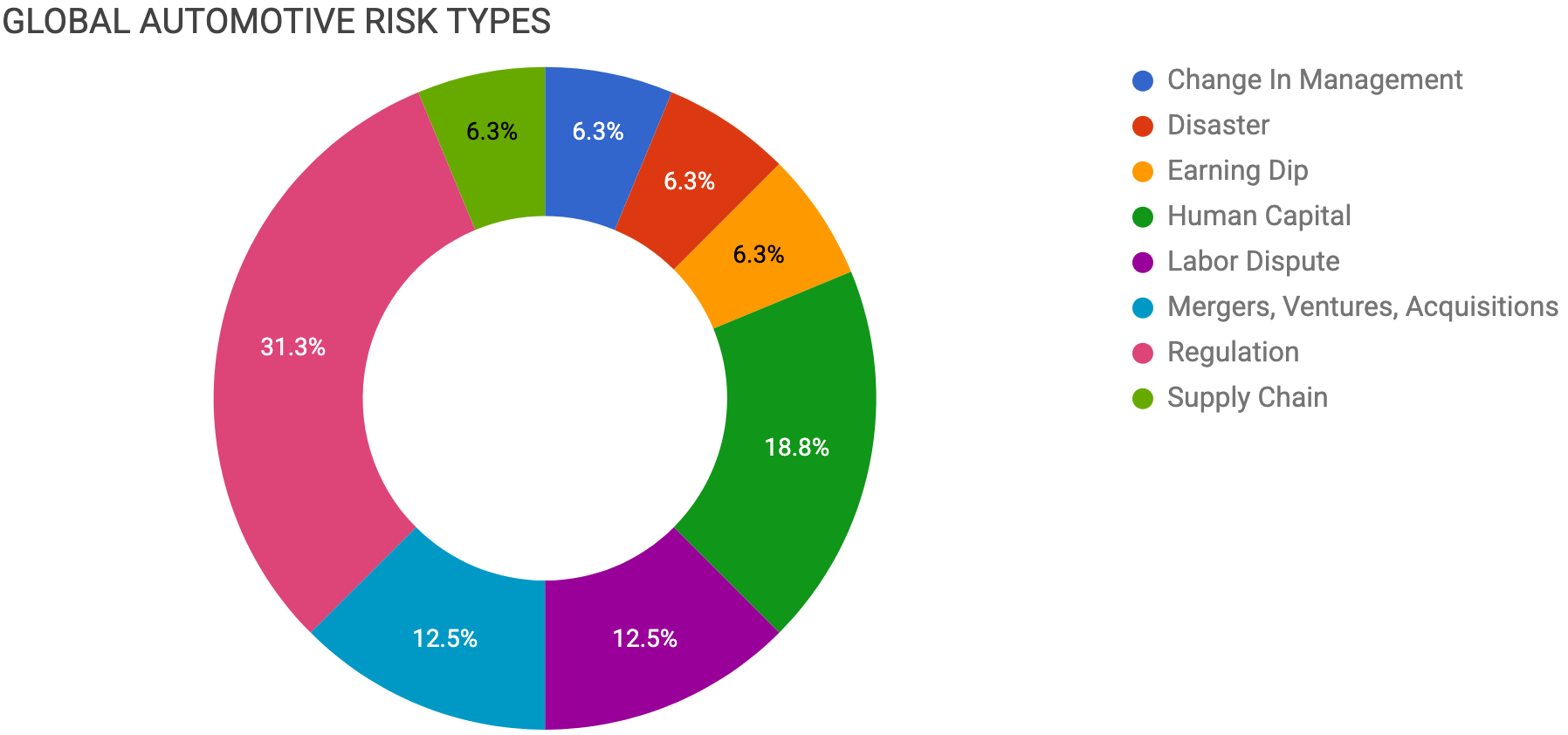
CHANGE IN MANAGEMENT
Cybercab program manager exits pre-launch
DISASTER
Cartel unrest disrupts Mexican logistics
EARNING DIP
Stellantis posts massive EV-related loss
HUMAN CAPITAL
Aston Martin cuts 20% workforce
Lucid reduces staff to conserve cash
INDUSTRY DIRECTIONS
Humanoid Robots… Horsenoid Robots?
LABOR DISPUTE
VW Chattanooga workers ratify UAW contract
Tesla Grünheide union clash threatens expansion
MERGERS, VENTURES, ACQUISITIONS
Hyundai plans major Korea tech investment
Novonix sells Canadian battery unit
REGULATION
Supreme Court blocks tariffs
New 150-day global tariff announced
Post-IEEPA tariff guidance playbooks
China restricts rare-earth exports to Japan
SUPPLY CHAIN
Nio ES8 hit by chip shortage

Change In Management
Victor Nechita, the program manager for Tesla’s Cybercab, has left the company just days after the first production unit was completed at Giga Texas.
His departure is the latest in a series of senior exits, following the recent departures of the program leads for the Cybertruck and Model Y. As a result, Tesla no longer has its original program managers in place for any of its current production vehicles.
The Cybercab is still ramping up production slowly and is designed around unsupervised autonomy, a capability that has not yet been achieved.
These technical and operational challenges increase execution risk as the vehicle moves from pilot builds to full-scale manufacturing. The leadership turnover adds further uncertainty to the launch at a crucial time for this new, autonomy-focused vehicle.

Disaster
After the death of cartel leader El Mencho, more than 250 road blockades were reported across 20 Mexican states, with highways obstructed by burning vehicles and spikes.
Airports in Guadalajara and Puerto Vallarta saw disruptions, and Jalisco halted public transport under a “code red.”
The unrest exposed how quickly security incidents can disrupt automotive logistics flows in key automotive manufacturing corridors.

Earning Dip
Stellantis reported a $26.3B net loss after booking charges tied to canceled EV platforms, including the Ram 1500 EV and Jeep Wrangler 4xe programs, as well as a stake sale in a Canadian battery plant.
CEO Antonio Filosa said the loss “reflects the cost of overestimating the pace of the energy transition,” as the company pivots back toward hybrids and internal combustion models, including the relaunch of Hemi V8 variants and legacy nameplates.
The company is issuing bonds and pausing shareholder payouts to stabilize its balance sheet.
The strategic reset signals capital reallocation, supplier program cancellations, and potential capacity shifts across EV and battery supply chains, increasing near-term sourcing volatility.

Human Capital
Aston Martin will cut up to 500 jobs, about 20% of its workforce, to save around $50M after posting a pre-tax loss of $459M in 2025.
Management cited US tariff impacts, supply chain challenges, and very weak demand in China as key drivers of lower volumes and margins.
The restructuring may help stabilize costs, but it could also constrain output recovery and lead to more volatile, stop-start ordering patterns for suppliers.

Lucid has cut 12% of its US staff as it pushes for profitability, while preserving hourly manufacturing roles at its Arizona plant.
The cuts come as the company leans on a lower-priced SUV and richer incentives to sustain volumes, generate cash, and fund its next midsize platform.
Despite these efforts, the company expects only moderate 2026 production growth, reflecting continued exposure to material shortages and global sourcing complexity.

Industry Directions
The CCTV Spring Gala is the most-watched event in China each year.
Last year, people were amazed by a highly synchronized traditional folk dance performed with dancers and Unitree Robotics’ humanoid robots.
This year was something else... same company, just one year of innovation later. Not only does this year’s performance show how fast humanoid robots are advancing, but also how fast China is moving in this space and in automotive manufacturing.
Robots like these are quickly moving from choreographed stages to real work. It is also not just humanoids, though. The same capabilities behind them, sensing, balance, actuators, and rapid iteration, are starting to show up in entirely different machines.
Which makes Kawasaki’s CORLEO feel less like a gimmick and more like a preview of what happens when you have its motorcycle and robotics divisions under one roof.
Kawasaki is now pushing CORLEO toward commercialization as a four-legged, hydrogen-fuel-cell off-road mobility platform (e.g., Electric Horse) that borrows ideas from motorcycle-style suspension and is being positioned for real deployment at Expo 2030, with a longer commercialization horizon beyond that.

Labor
VW Chattanooga workers have approved their first UAW contract with 96% support, securing 20% wage increases, lower healthcare costs, and stronger job security protections.
The ratification follows the plant’s April 2024 unionization vote and several months of negotiations, including the threat of strike action.
For automotive manufacturers and suppliers in the region, the agreement signals a potential shift in labor dynamics across Southern US manufacturing hubs.
Tesla’s Grünheide plant is heading into works council elections where the German union IG Metall is trying to gain more influence, and Tesla management is pushing back against that effort.
Elon Musk and local management have implied that a planned plant expansion may not go ahead if “external organizations” like the union gain stronger representation through the works council.
At the same time, both Tesla and IG Metall have filed complaints related to an alleged secret recording at a works council meeting, and have then reached a limited settlement so the election can proceed.

Mergers, Ventures, Acquisitions
Hyundai is expected to announce a multi-billion-dollar investment in the Saemangeum region, focusing on robotics, an AI data center, and hydrogen infrastructure.
This move supports Hyundai’s push into autonomous driving, smart factories, and robotics, with plans to purchase up to 50,000 Nvidia AI chips.
The South Korean buildout could reshape supplier footprints and logistics flows in Korea as new automation and hydrogen capacity come online.
Novonix is selling its Nova Scotia battery-testing business to founder Chris Burns for $1, including the unit’s assets and liabilities.
The divestment allows Novonix to narrow its focus and accelerate growth in its US synthetic graphite production, particularly at its Chattanooga anode materials plant.

Regulation
The US Supreme Court ruled 6-3 that President Trump lacked the authority under the IEEPA to impose certain national-level tariffs.
Within a day, he responded by introducing a 15% global duty under Section 122 of the Trade Act of 1974.
Vehicles and auto parts already covered by Section 232 tariffs are not affected by this new duty, nor are steel, aluminum, copper, or USMCA-compliant goods from Canada and Mexico.
Section 232 and Section 301 tariffs still apply, including those on vehicle imports, parts, and metals.
The new global tariff will last up to 150 days unless Congress extends it.
The White House also indicated that more Section 301 investigations could lead to additional tariffs.
For supply chains, this decision removes some overlapping tariffs but keeps auto sector tariffs in place and adds ongoing legal and refund uncertainty.
Companies will need to keep updating their cost models and stay alert to trade compliance.
Foley has published the first 3 of 5 in their post-IEEPA-tariffs playbook series:
Also worth checking out:
China has introduced new export controls on rare-earth and other dual-use materials for 20 Japanese companies, including Subaru, Hino, Mitsubishi Materials, TDK, Nitto Denko, and NOF Corp.
Exporters must now obtain special permits and demonstrate that the materials will not be used for military purposes.
These requirements add extra compliance steps, increase documentation requirements, and increase the risk of shipment delays for key automotive materials used in engines, electronics, and EV systems.
As a result, Japanese automakers that rely on rare-earth materials from China face higher exposure to supply disruption, longer lead times, and potential cost increases.

Supply Chain
Nio’s ES8 SUV is facing a shortage of signal-processing chips, triggering a temporary production change starting March 2.
Vehicles will ship without the “Hyper-Immersive” sound system mode, with financial compensation and a paid retrofit option offered at a later date.
This is the ES8’s second chip-related production change since launch, a reminder that semiconductor risk is still a live issue for EV programs.