Dear Reader,
As the year begins to wind down and many of us take a moment to reflect, I want to say a sincere thank you. For reading. For sharing. And for being part of this growing community.
Writing this newsletter is a small way to stay connected with people who care deeply about the resilience and integrity of the automotive supply chain.
It’s more than analysis and alerts. It’s about building a network of professionals who believe in better communication and collaboration between suppliers and their customers.
Whether you’re in the US, still full from celebrating Thanksgiving, or simply pausing for a break this Friday, I hope you get a moment to recharge. We’re grateful to have you with us.
Warmly,
Nick Gaydos
Editor, Automotive Supply Chain Risk Digest
Elm Analytics
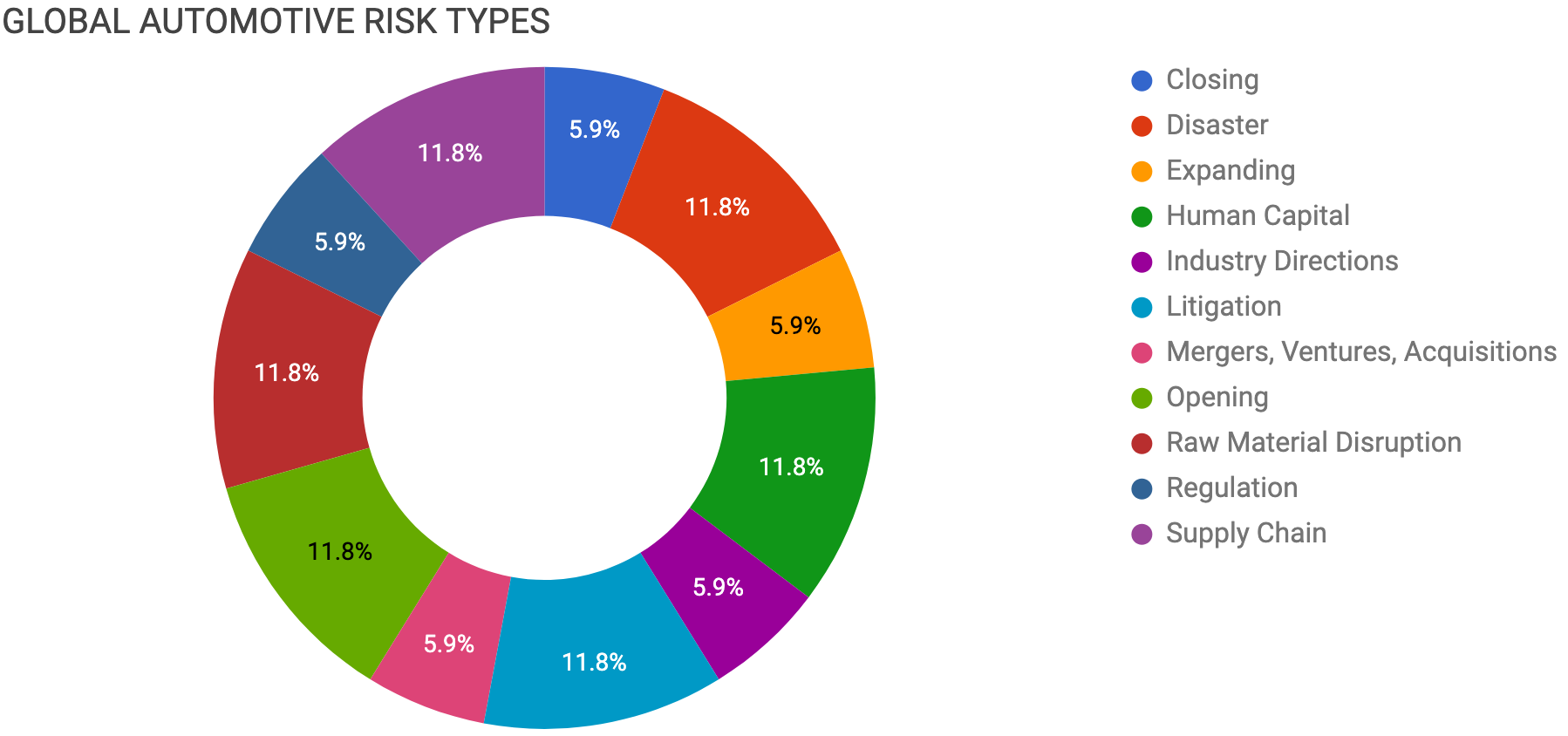
Contents
CLOSING
Continental closing Aldora Mills plant
DISASTER
Novelis partially restarts fire-hit plant
Fire evacuates Vistech Ohio facility
EXPANDING
Carlex expanding Nashville glass capacity
HUMAN CAPITAL
Yanfeng cutting 192 Romulus jobs
Autokiniton planning 165 Detroit layoffs
INDUSTRY DIRECTIONS
Automakers boosting supply chain collaboration
LITIGATION
EV delays driving supplier litigation
First Brands faces CEO fraud claims
MERGERS, VENTURES, ACQUISITIONS
Changan acquiring idled Hyundai plant
OPENING
Schaeffler opening China logistics hub
Dual Borgstena launching Mexico plant
RAW MATERIAL DISRUPTION
Addressing future automotive material risks
EV motors shifting from rare earths
REGULATION
India warns of Mexico tariff impact
SUPPLY CHAIN
Protest blocks key Mexico-US crossing
Nexperia chip crisis disrupts supply chains

Closing
Continental plans to shut down its Aldora Mills plant in Barnesville, Georgia, which currently employs about 230 people. The facility produces textile reinforcement materials used in the company’s tire and industrial products, including tire cord fabric, hose yarn, and knitted fabric. Layoffs will begin in stages starting in March, and the plant is scheduled to fully close by the end of 2026.

Disaster
Novelis has restarted cold-mill and heat-treatment operations at its fire-damaged aluminum plant in Oswego, New York, and continues to ship finished material to Ford. The company expects its hot mill to be back online by the end of December and is using other plants to cover remaining gaps.
This partial recovery, along with the planned Bay Minette, Alabama, plant, reduces but does not eliminate near-term supply risk for Ford’s F-Series, which already faces an estimated 90k to 100k-unit production hit.

A fire at Vistech Manufacturing Solutions in West Chester Township, Ohio, triggered a full evacuation and a multi-department emergency response. No injuries were reported, but short-term production delays are possible. Vistech supplies die-cut acoustic components, soft trims, and flooring underlayments used for vehicle noise and vibration control.

Expanding
Carlex Glass America is expanding its Nashville, Tennessee, plant by mid-2026 with a nearly $55M investment. The project will add new production lines for larger precision-formed automotive glass, increasing North American capacity and improving supply reliability for OEM programs that use its windshields and roof glass.

Human Capital
Yanfeng plans to lay off 192 employees at its Romulus, Michigan, interior trim and electronics plant by early January as it shifts some operations to other sites. The cuts will primarily affect plant and assembly operators, as well as related support roles.
Autokiniton will close its Oakland Stamping body-frame structural assembly facility in Detroit, Michigan, by early 2026. WARN notices cover 165 layoffs across production and technical roles, starting in December and January.
This closure, along with Yanfeng’s, reduces available capacity and adds to a broader pattern of Michigan auto supplier plant closures, potentially affecting sourcing flexibility in the region.

Industry Directions
It was great to meet so many Automotive Supply Chain Risk Digest readers at the MEMA Annual Conference last week.
The most encouraging theme was clear: supply chain resilience is moving from a talking point to real execution.
Automotive News echoed that shift, reporting that years of disruption and new Trump-era tariffs are pushing automakers to build shared data and collaboration with every tier of the supply chain, not just at Tier-1.
Leaders at GM, Ford, Stellantis and Valeo stressed that trust-based transparency with Tier-1, Tier-2 and below is now critical for mapping risk, spotting bottlenecks, and responding quickly to supply chain shocks, while still protecting sensitive commercial information.
For buyers and supply chain teams, the takeaway is straightforward:
Shared data and closer collaboration between automakers and all tiers of the supply base can materially reduce exposure to disasters, geopolitical shifts, and material disruptions that threaten production stability.

Litigation
EV strategy resets at OEMs are cascading into litigation, cash stress, and potential instability among lower-tier suppliers, raising supply chain risk around future EV launches.
Automakers that overestimated EV demand are delaying and canceling programs, which is leaving smaller suppliers with stranded capital, thin margins, and mounting pressure to recover sunk costs.
The dispute between Tier-1 Nexteer and Tier-2 Swoboda is one visible example: Swoboda is suing to recover about $3M in tooling and machinery after Nexteer canceled orders tied to Ford’s delayed next-gen electric pickup.
While large Tier-1 suppliers can usually absorb program cancellations and delays, smaller parts makers are far less equipped to do so.
Steven Wybo, Senior Managing Director at Riveron Consulting, warned that sub-$1B suppliers that committed 10% to 15% of their business to BEV programs “don’t have the luxury of the capital markets or a bunch of cash sitting around to weather it.”
For buyers, the risk is that seemingly isolated EV program changes at OEMs can lead to heightened financial fragility and potential disruption among lower-tier suppliers.
First Brands Group’s $10B bankruptcy now includes a lawsuit accusing its former CEO of large-scale financing fraud and misappropriation. The case layers governance and credit risk on top of existing operational uncertainty for suppliers and customers as the restructuring unfolds.

Mergers, Ventures, Acquisitions
Changan has acquired Beijing Hyundai’s idled 300k-unit Chongqing plant in China to build its Deepal EVs, helping close a capacity gap as the company targets 3M sales next year.

Opening
Schaeffler has opened a new logistics center in Taicang, Suzhou, China. The site is now the main hub for raw material flows into the Taicang manufacturing base and for consolidating outbound shipments from nine plants across China. It supports the distribution of automotive bearings, powertrain and chassis components, and e-drive products to customers across the region.
South Korea’s Dual Borgstena has opened a new manufacturing plant in Monclova, Coahuila, Mexico, just eight months after breaking ground in March. The facility, backed by an initial $15M investment, will produce car seat covers, textiles, and interior moldings. It is expected to create 880 direct jobs once fully ramped, with phase one launching at roughly one-third of that headcount.

Raw Material Disruption
Foley: Securing the Future: Tackling Automotive Material Challenges in a Changing World
NYTimes: An Auto Holy Grail: Motors That Don’t Rely on Chinese Rare Earths

Regulation
India’s auto manufacturers and component suppliers have warned their government that Mexico’s proposed tariff hike on imports from non-free-trade-agreement countries would sharply raise duties on passenger vehicles and auto parts, putting India’s $887M auto export market at risk.
Mexico plans to increase tariffs on passenger vehicles from 20% to 50% and on auto parts from a current range of 0% to 35% to a higher band of 10% to 50%, with implementation possible as early as January.
The higher tariffs would erode price competitiveness for Indian OEMs and parts makers, increase costs and market-access risk, and could force rerouting of supply chains serving Mexico and downstream US customers.

Supply Chain
On November 24, farmers and agricultural workers from Chihuahua, protesting changes to water rights, blocked cargo lanes at the Ysleta-Zaragoza International Bridge, a key border crossing between Mexico and the US.
The action temporarily halted maquila-related truck traffic.
Even short-lived disruptions like this at major ports of entry can upset just-in-time cross-border flows and create immediate delivery risk for OEM and Tier-1 automotive plants that rely on the Juarez/El Paso corridor.