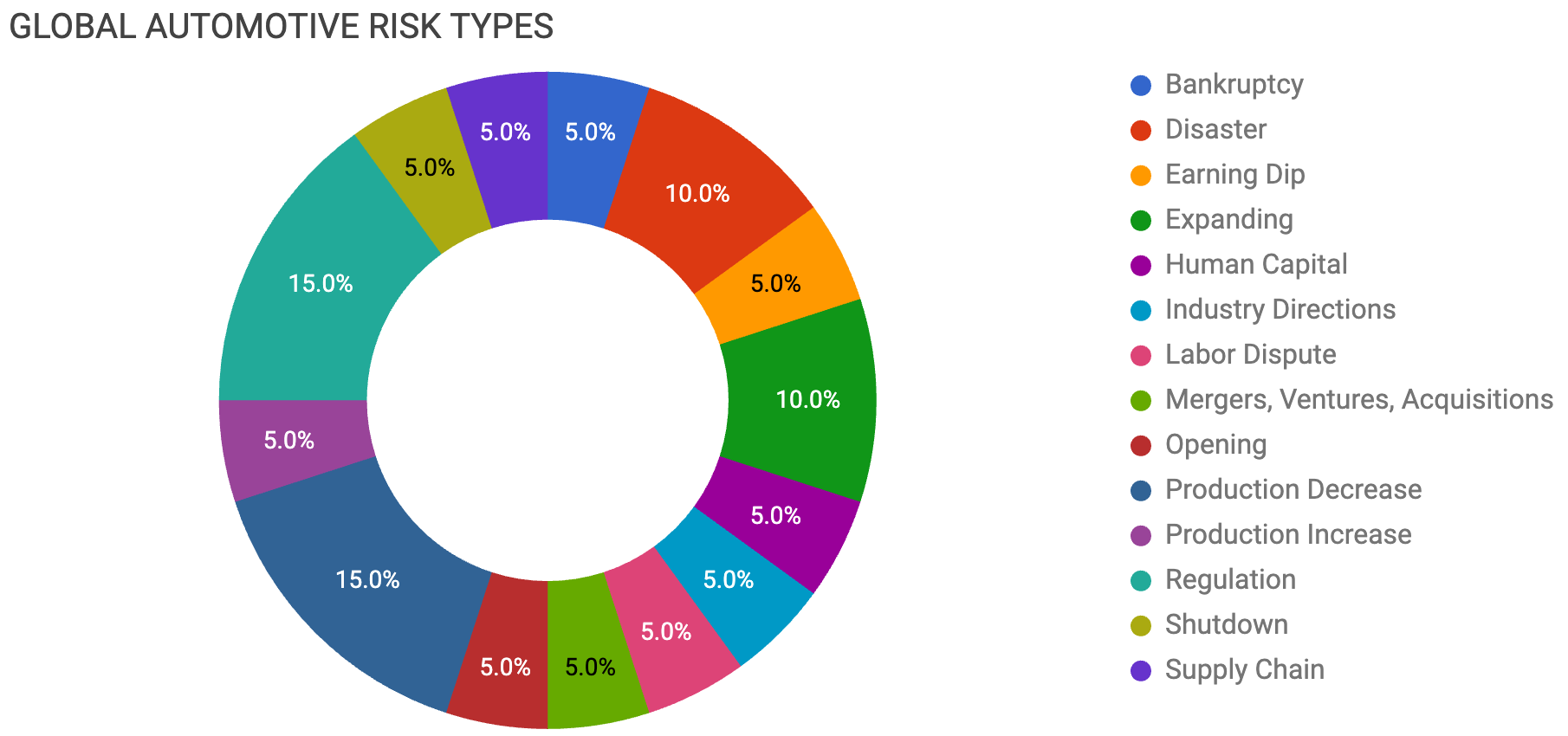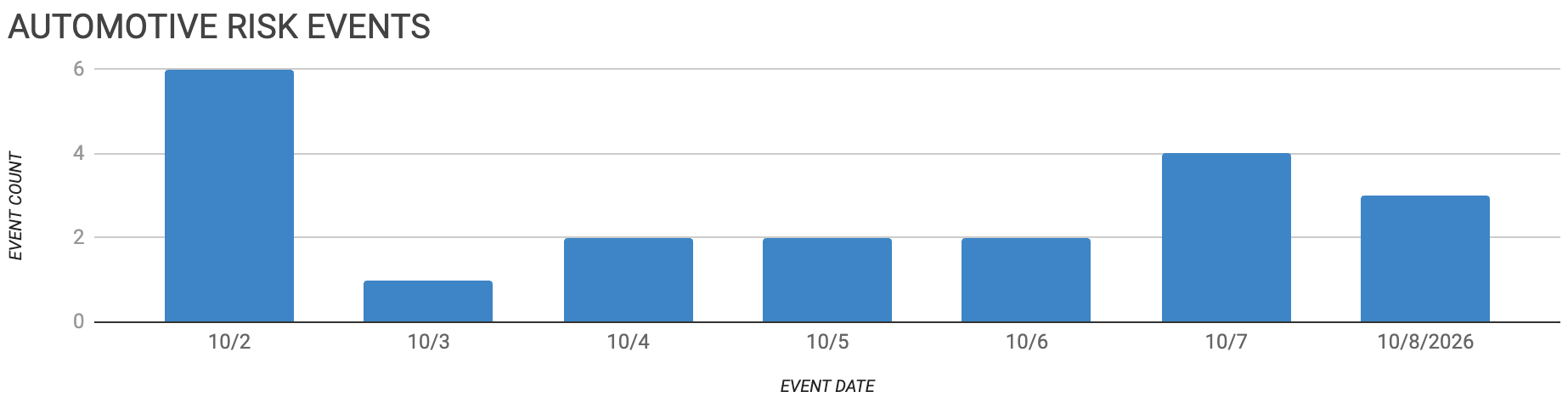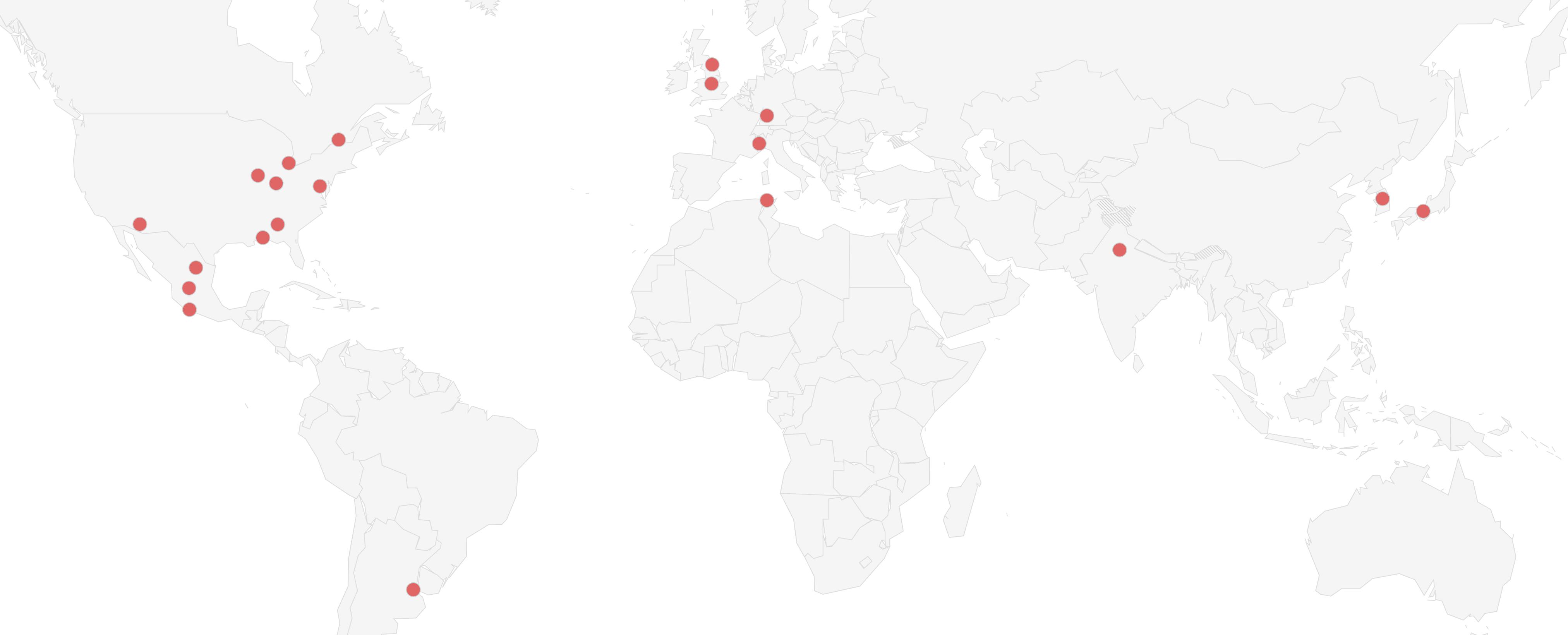
Contents
BANKRUPTCY
Spectra Premium enters creditor protection again
DISASTER
Storm Simón closes Mexican auto gateway
Hurricane Isaias shuts Mobile port terminals
EARNING DIP
JLR cyberattack slashes OPmobility supplier revenue
EXPANDING
Toyota plans major Argentina EV investment
Hyundai Transys expands Georgia powertrain manufacturing
HUMAN CAPITAL
GM cuts Ramos Arizpe workforce
INDUSTRY DIRECTIONS
Porsche rejects US plant despite tariffs
LABOR DISPUTE
Stellantis extends Windsor plant downtime
MERGERS, VENTURES, ACQUISITIONS
Nidec considers selling automotive motors business
OPENING
Kromberg & Schubert opens Tunisian plant
PRODUCTION DECREASE
Stellantis cuts Italian production forecast
Honda postpones CR-V and Civic plans
Lucid scales back vehicle production
PRODUCTION INCREASE
Rivian increases output with R2 ramp
REGULATION
USMCA review opens amid trade tensions
Chinese automakers pause Mexican factory plans
UK weighs Chinese vehicle tariff dilemma
SHUTDOWN
Fatal accident triggers Korean plant stoppage
SUPPLY CHAIN
Suzuki quality mandates regular Indian supplier downtime

Bankruptcy
Fuel tank maker Spectra Premium has entered creditor protection under Canada's Companies' Creditors Arrangement Act for the second time in six years, after failing to refinance about $27.5M of secured debt. Its OEM division, which accounts for about 40% of revenue, builds gas tanks for automakers at a Boucherville, Québec, plant with 287 workers. The rest is aftermarket fuel, cooling, and undercar parts. Sales fell 19% over two years to $117.1M in 2025, and losses grew to $21.2M, as light vehicles used fewer metal fuel tanks and OEM programs were phased out. The cash squeeze then hit operations. Suppliers held back parts over late payments, and first-half 2026 revenue came in 24% below budget. EY is now selling the entire business, funded by up to $14.5M in debtor-in-possession financing from Wells Fargo. The earlier sale effort covered only the aftermarket business. The OEM fuel tank business is now on the block for the first time, and automakers still sourcing tanks from Boucherville should be confirming an alternate path.

Disaster
Storms shut two ports serving North American auto production this week. Mexican authorities closed the port of Lázaro Cárdenas (Mexico's main Pacific gateway for Asian parts containers moving by rail to central Mexico) to all vessel traffic as Tropical Storm Simón approached. Forecasters expected Simón to strengthen into a Category 1 hurricane within 24 to 36 hours, with warnings along the coasts of Guerrero, Colima and Michoacán.
On the Gulf side, the Alabama Port Authority suspended vessel operations at its public berths in Mobile, Alabama's only deepwater port, at noon on Oct. 8 and closed its terminals at the end of the day ahead of Hurricane Isaias. The Coast Guard set Port Condition Yankee, meaning gale-force winds are expected within 24 hours, and ships now need its permission to enter. Restart times depend on the storm. Simón and Isaias follow Hurricane Polo, which idled GM's Ramos Arizpe plant late last month.

Earning Dip
OPmobility Exterior UK, formerly Plastic Omnium Automotive, lost about $62M in revenue in 2025 after a cyberattack on JLR halted its just-in-sequence assembly lines. Revenue fell 18.5% to about $273M, and operating profit dropped 22% to about $20M. The Measham-based plastic exterior parts maker builds assemblies to individual vehicle orders hours before delivery, so when JLR's line stopped, its own lines stopped too. Without the attack, revenue would have fallen by about 6% due to lower activity and model phase-outs. Average headcount fell to 890 from 944. The filing shows what one OEM cyberattack does to a just-in-sequence supplier: revenue falls on the customer's line while fixed costs remain unchanged. JLR put its own cost at about $270M, as Issue #499 reported.

Expanding
Toyota will invest about $1.3B to build a new electric vehicle at its Zárate plant in Buenos Aires province, the largest investment in Argentina's auto industry to date. The project won approval under Argentina's Incentive Regime for Large Investments (RIGI) and will create about 3.6k construction jobs and about 2.6k jobs once upgrades are complete. Zárate builds the Hilux pickup, SW4 SUV and Hiace van today. Toyota has not named the model, though Automotive News reports the Hilux BEV, now built in Thailand, is a likely candidate. Argentina's economy minister expects about $1.28B in annual exports, with roughly 70% of output going abroad. A 70% export share positions Zárate as a regional EV hub targeting the same Latin American markets where BYD accounts for nearly 60% of EV sales.
Hyundai's powertrain and seating affiliate is investing too. Hyundai Transys will spend almost $560M to expand its West Point, Georgia plant and add 320 jobs to its current 1.25k (about a week after the $500M Hyundai Alabama investment covered in Issue #502). The project upgrades plants one and two, builds a third plant, and adds capacity for hybrid-electrified powertrains. West Point is also home to Kia's assembly plant, which employs about 3k.

Human Capital
General Motors is laying off about 200 workers at its Ramos Arizpe complex in Coahuila, Mexico, as production of the gas-powered Chevrolet Blazer ends this month. The plant will keep building the Equinox EV, Blazer EV and Cadillac Optiq. Space from the gas Blazer line will be retooled for the Chevrolet Groove (a model GM currently imports from SAIC-GM-Wuling in China), with production starting in 2027. A board member of the Coahuila Automotive Industry Cluster says GM is seeking new local suppliers of powertrain components. Plants in the state are running at about 80% of capacity on average, and new investment has stalled. Mexico's 50% tariff on Chinese-built vehicles, covered later in this issue, gives GM good reason to build the Groove locally.

Industry Directions
Porsche's turnaround plan, laid out by its new CEO Michael Leiters, rules out a US assembly plant despite tariffs. Porsche paid about $811M in tariffs in 2025 to ship cars from Europe to the US, which takes nearly 30% of its sales, and expects similar costs in 2026. Leiters said Porsche's volume does not justify a factory, though he would look at an option within the Volkswagen Group. The product plan adds electric 718 Boxster and Cayman models in 2027 and a gas and plug-in hybrid B-segment crossover in 2028. Porsche aims to break even at under 200k vehicles after 2025 operating income fell 93% to $465M. No US plant means roughly $800M a year in tariffs stays on the books, and the supply base stays in Europe.

Labor
Stellantis will idle its Windsor Assembly Plant for three more weeks starting Oct. 19, returning around Nov. 9, just after a two-week layoff. The plant employs about 6k workers across three shifts, building the Chrysler Pacifica, Grand Caravan, and Voyager minivans, as well as the Dodge Charger. Stellantis cites market conditions, consumer demand, and tariffs. The downtime lands while Canadian contract talks remain stalled. They broke down Sept. 11 over the planned sale of the Brampton Assembly Plant to defense contractor Roshel, which Unifor rejects.

Mergers, Ventures, Acquisitions
Stellantis has a supplier question in Europe, too. Nidec, still working through an accounting scandal that led to more than $6.9B in write-downs and charges, plans to sell low-profit units, including its automotive motors business, and refocus on data center, power generation, and energy storage equipment. Nidec owns half of eMotors, a joint venture with Stellantis that builds electric motors, inverters, and reducers for Stellantis EVs in France and employs 700 people. Nidec also has auto plants in Poland and Serbia, supplies BMW and Volkswagen Group, and makes motors and control units for brakes and steering. Separately, it agreed to sell switch and pressure sensor maker Nidec Components to a Carlyle affiliate for about $646M. A sale would place eMotors' motor, inverter, and reducer programs under a new partner mid-life, and Stellantis has not said what will happen to the joint venture.

Opening
German wiring harness maker Kromberg & Schubert has opened a second plant in Beja, Tunisia, focused on electric vehicle wiring for several German automakers. Beja 2 covers about 646k ft² and will cost about $102M. It already employs about 2.6k people and plans to reach about 7.5k by 2029, bringing the two Beja plants to nearly 14.7k. The original Beja plant mainly serves combustion vehicles. Harness assembly remains labor-intensive, which is why EV wiring capacity for German automakers continues to be located in North Africa.

Production Decrease
Stellantis is on track to build about 450k vehicles in Italy this year, 10% below an earlier forecast, according to the Fim-Cisl union. Stellantis declined to comment on the figures. The cut stems from production stoppages at Mirafiori, where output of the hybrid Fiat 500 is now expected to be about 60k, against a 100k goal. Battery and other component shortages, along with weak demand for models such as the hybrid 500, are causing plant shutdowns in Italy and France this month. Nine-month output is still up 28% on a 2025 level that fell to its lowest level since the mid-1950s. The exception is Cassino, which builds the Maserati Grecale and older Alfa Romeo models. Its output is down 37%, and it runs five or six days a month. That makes Cassino effectively a standby plant, and its local suppliers are likely carrying the cost.
Honda has delayed the next-generation CR-V by three months to April 2027 and cut planned monthly volume in the first production year by 6.7%, to about 41.3k units, a supply chain source told Automotive News. Honda declined to comment. It is prioritizing the current CR-V, with dealer inventory at about a 17-day supply. The source said Honda also canceled plans to build the next Civic in Greensburg, Indiana, starting in May 2028. The plant is North America’s only source of the Civic hatchback, which will now come from Japan. Civic sedan production in Ontario stays on schedule. AutoForecast Solutions says the change frees capacity at Greensburg, a roughly 250k-unit plant, for the more profitable CR-V.
Lucid built about 3k vehicles in the third quarter, down 38% from the second quarter, while deliveries slipped 7% year over year to 3.8k. The cut is deliberate. New CEO Silvio Napoli is selling down inventory that piled up in the first half, when a supplier problem with second-row seats held Gravity deliveries for 29 days while the line kept running. Lucid dropped the second shift at Casa Grande, Arizona, in June and withdrew its 2026 production target. Its plan targets $1.4B in cash improvements this year, including $600M to $800M from inventory and about $500M from lower capital spending. The capital spending cut lands on tooling and equipment suppliers, and the Cosmos delay to the second half of 2027 pushes new-program volume further out.

Production Increase
Rivian is the other side of that comparison. It built 19.8k vehicles and delivered 19.2k in the third quarter, with deliveries up 58% from the second quarter as the R2 ramps at Normal, Illinois. Rivian is selling only the higher-priced R2 Performance through year-end and reaffirmed full-year delivery guidance of 65k to 70k.

Regulation
The US Trade Representative has opened public comments ahead of the next joint review of the US-Mexico-Canada Agreement (USMCA), with a Jan. 12, 2027 deadline. Because the three countries did not agree to extend the deal this year, they must review it annually until they reach an agreement or the pact expires in 2036. The next review deadline is July 1, 2027. The two tracks look very different. Mexico and the US held a third round of bilateral talks in late July, and Mexico’s economy secretary says the sides are getting close. The US and Canada are in a trade war, with 50% US tariffs on about $20B of Canadian goods since August, Canadian retaliation, and a wider US list that now includes import bans.
The review is already freezing investment. BYD, Chery (sold in Mexico as Chirey), MG, Geely, Great Wall and GAC have all delayed or paused Mexican assembly plans. They fear the review will cap the Chinese content of parts and materials in vehicles that qualify for duty-free trade, on top of the 75% regional value content rule. BYD has dropped its plant plans, MG has not picked a site for its $1.05B plant, and Geely did not close a deal for the former Mercedes-Benz lines at the COMPAS plant in Aguascalientes. Mexico's 50% tariff on imported Chinese vehicles still gives them every reason to localize, and Nissan Americas President Christian Meunier expects Chinese production in Mexico within 24 to 36 months. For Mexican Tier 2 and Tier 3 suppliers, the freeze removes a pipeline of new OEM customers at least until the July 2027 review deadline.
Britain faces its own version of the China question. The UK has no tariffs on Chinese vehicles, while the EU charges duties of up to 45%, and EU officials have reportedly warned that British-built cars could be shut out of Made in Europe rules unless that changes. Those rules limit subsidies, tax breaks and public contracts to vehicles built in the EU. The UK government has resisted so far, arguing tariffs would likely draw Chinese retaliation and could deter investors such as Chery, which is in talks to build cars at Nissan’s Sunderland plant. For UK Tier 1s, the export split matters most: 58% of UK car exports went to the EU in the first half and about 4% to China.

Shutdown
A 45-year-old contract worker was killed on Oct. 4 inside a kiln at Hyundai Sungwoo Casting’s auto parts plant in Chungju, South Korea, when the equipment started up. The labor ministry ordered a work stoppage and opened an investigation under the Serious Accidents Punishment Act. The plant machines aluminum wheels and has outsourced all work except painting since 2019. The Korean Metal Workers’ Union says ministry inspectors made a surprise inspection of the plant a week before the death. Korean work stoppage orders stay in place until regulators accept corrective measures, so wheel output at Chungju depends on how quickly that happens.

Supply Chain
Accident risk is also behind a new directive in India. Suzuki has asked its Indian suppliers, for the first time, to stop production one day a week for machine maintenance, two people told Reuters. Maruti Suzuki wants suppliers to sign declarations by year-end that lines making its parts do not run seven days a week, and to move to 20 hours a day, six days a week by September 2027. The goal is to prevent accidents, unplanned stoppages, and quality problems as Maruti lifts output from about 2.4 M to 4M cars a year by 2030. Indian parts makers usually run around the clock, so many will need new plants and machinery to make up the lost hours, just as raw material prices climb. Going from round-the-clock running to 20 hours a day, six days a week cuts available machine hours by about 29%, while Maruti plans a 67% output increase by 2030.